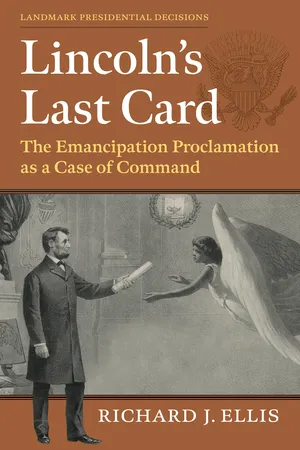
A fresh reassessment of the Emancipation Proclamation that looks beyond the Lincoln mythos and sees the decision as Lincoln's last resort after his failure to persuade a divided country.
There is a certain comfort in being able to see Lincoln—or any president—simply as either a hero or a villain. The truth, however, is more complicated. Lincoln’s Last Card helps us look beyond the myths to see Lincoln as the flawed and consequential leader that he was.
Few presidential edicts are more famous or misunderstood than the Emancipation Proclamation. The traditional myth about the proclamation is that President Lincoln freed the slaves with a bold stroke of his pen. This popular understanding deifies Lincoln as the sagacious Great Emancipator and constructs a narrative of American history centered around the heroic deeds of our “great” presidents. A more cynical view, bolstered by recent historical examinations of Lincoln’s own racial biases, says the proclamation was much ado about nothing; a largely hollow gesture that freed no slaves at all and lacked even a moral indictment of slavery. Both views, however, see presidential power as largely unrestricted and unilateral, so that Lincoln’s decisions occur in a virtual vacuum—a timeless display of his moral virtue, or lack thereof.
Richard Ellis, a veteran scholar of the American presidency, suggests that we look at Lincoln’s proclamation through the lens of presidential weakness rather than greatness. To do so, Ellis draws on the work of renowned political scientist Richard Neustadt, who explored “three cases of command” from the twentieth century in his 1960 work, Presidential Power. Where the public saw presidential success, Neustadt saw presidents engaged in “a painful last resort,” suggesting not political mastery but rather the failure to achieve goals through other means. Ellis applies this same perspective to the Emancipation Proclamation, showing how Lincoln’s great success was, in fact, his last card. Lincoln’s original hope was to persuade the border states to endorse his plan for gradual, compensated abolition, preferably coupled with some level of voluntary colonization. Contrary to conventional wisdom and in contrast to Lincoln’s reputation as the greatest presidential orator, Ellis shows how the Emancipation Proclamation was a sign of Lincoln’s failure to persuade.