2024 Daniel E. Griffiths Research Award Winner
2024 Outstanding Academic Title, given by Choice Reviews
An expansive volume presenting crip approaches to writing, research, and publishing.
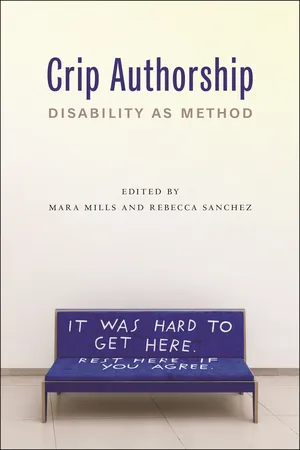
Crip Authorship: Disability as Method is an expansive volume presenting the multidisciplinary methods brought into being by disability studies and activism. Mara Mills and Rebecca Sanchez have convened leading scholars, artists, and activists to explore the ways disability shapes authorship, transforming cultural production, aesthetics, and media.
Starting from the premise that disability is plural and authorship spans composition, affect, and publishing, this collection of thirty-five compact essays asks how knowledge about disability is produced and shared in disability studies. Disability alters, generates, and dismantles method. Crip authorship takes place within and beyond the commodity version of authorship, in books, on social media, and in creative works that will never be published.
The chapters draw on the expertise of international researchers and activists in the humanities, social sciences, education, arts, and design. Across five sections—Writing, Research, Genre/Form, Publishing, Media—contributors consider disability as method for creative work: practices of writing and other forms of composition; research methods and collaboration; crip aesthetics; media formats and hacks; and the capital, access, legal standing, and care networks required to publish. Designed to be accessible and engaging for students, Crip Authorship also provides theoretically sophisticated arguments in a condensed form that will make the text a key resource for disability studies scholars.
Essays include Mel Y Chen on the temporality of writing with chronic illness; Remi Yergeau on perseveration; La Marr Jurelle Bruce on mad Black writing; Alison Kafer on the reliance of the manifesto genre on disability; Jaipreet Virdi on public scholarship for disability justice; Ellen Samuels on the importance of disability and illness to autotheory; Xuan Thuy Nguyen on decolonial research methods for disability studies; Emily Lim Rogers on virtual ethnography; Cameron Awkward-Rich on depression and trans reading methods; Robert McRuer on crip theory in translation; Kelsie Acton on plain language writing; and Georgina Kleege on description as an access and aesthetic technique.
- English
- ePUB (mobile friendly)
- Available on iOS & Android
eBook - ePub
About this book
Information
Table of contents
- Cover
- Half Title
- Title Page
- Copyright
- Contents
- Half Title
- Introduction: On Crip Authorship and Disability as Method
- Section I: Writing
- Section II: Research
- Section III: Genre/Form
- Section IV: Publishing
- Section V: Media
- Acknowledgments
- About the Authors
- Index
Trusted by 375,005 students
Access to over 1.5 million titles for a fair monthly price.
Study more efficiently using our study tools.
Frequently asked questions
Yes, you can cancel anytime from the Subscription tab in your account settings on the Perlego website. Your subscription will stay active until the end of your current billing period. Learn how to cancel your subscription
No, books cannot be downloaded as external files, such as PDFs, for use outside of Perlego. However, you can download books within the Perlego app for offline reading on mobile or tablet. Learn how to download books offline
Perlego offers two plans: Essential and Complete
- Essential is ideal for learners and professionals who enjoy exploring a wide range of subjects. Access the Essential Library with 800,000+ trusted titles and best-sellers across business, personal growth, and the humanities. Includes unlimited reading time and Standard Read Aloud voice.
- Complete: Perfect for advanced learners and researchers needing full, unrestricted access. Unlock 1.5M+ books across hundreds of subjects, including academic and specialized titles. The Complete Plan also includes advanced features like Premium Read Aloud and Research Assistant.
We are an online textbook subscription service, where you can get access to an entire online library for less than the price of a single book per month. With over 1.5 million books across 990+ topics, we’ve got you covered! Learn about our mission
Look out for the read-aloud symbol on your next book to see if you can listen to it. The read-aloud tool reads text aloud for you, highlighting the text as it is being read. You can pause it, speed it up and slow it down. Learn more about Read Aloud
Yes! You can use the Perlego app on both iOS and Android devices to read anytime, anywhere — even offline. Perfect for commutes or when you’re on the go.
Please note we cannot support devices running on iOS 13 and Android 7 or earlier. Learn more about using the app
Please note we cannot support devices running on iOS 13 and Android 7 or earlier. Learn more about using the app
Yes, you can access Crip Authorship by Mara Mills,Rebecca Sanchez in PDF and/or ePUB format, as well as other popular books in Law & Inclusive Education. We have over 1.5 million books available in our catalogue for you to explore.