Winner, 2025 Mary Nickliss Prize in U.S. Women's and Gender History, given by the Organization of American Historians
Examines the role marriage played in the lives of Japanese women during periods of racial exclusion in the United States
In 1908 the United States and Japan agreed to limit the migration of Japanese laborers to the US. The Gentlemen's Agreement of 1908 ushered in an era of exclusion for the Japanese, but an exception was made for Japanese women who migrated as wives of Japanese men. In 1924 that exception would end with the passage of the National Origins Act. Immediately after World War II, Japanese women were once again permitted to enter the US as brides— this time, however, as the wives of American servicemen stationed throughout Japan. The ban on Japanese immigration would not be lifted until 1952.
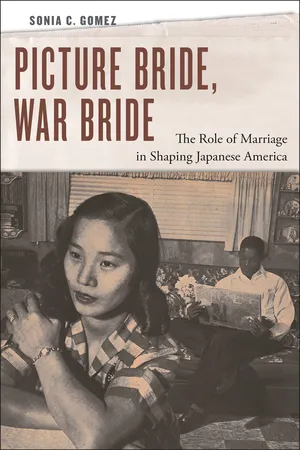
Picture Bride, War Bride examines how the institution of marriage created pockets of legal and social inclusion for Japanese women during the period of Japanese exclusion. Sonia C. Gomez begins with the first wave of Japanese women's migration in the early twentieth century (picture brides), and ends with the second mass migration of Japanese women after World War II (war brides), to illustrate how popular and political discourse drew on overlapping and conflicting logics to either racially exclude the Japanese or facilitate their inclusion via immigration legislation privileging wives and mothers. Picture Bride, War Bride retells the history of Japanese migration and exclusion by centering women, gender, and sexuality, and in so doing, troubles the inclusion versus exclusion binary. While the Japanese were racially excluded between 1908 and 1952, Japanese wives and mothers were permitted entry because their inclusion served American interests in the Pacific. However, the very rationale enabling their inclusion simultaneously restricted and defined the parameters of their lives within the US.
Picture Bride, War Bride serves as a compelling analysis of how the intricate interplay between societal norms and political interests can both harness and contradict the interconnected frameworks of race, gender, and sexuality.
- English
- ePUB (mobile friendly)
- Available on iOS & Android
eBook - ePub
About this book
Information
Table of contents
- Cover
- Half Title
- Title Page
- Copyright
- Dedication
- Contents
- Introduction
- 1. A Paradox of Exclusion: Women, Family, and Reproduction in Early Japanese America
- 2. Issei Bachelors: Unmarried Men at the Margins
- 3. The US Occupation of Japan and the Making of Postwar Japanese America
- 4. “A Bridge Between East and West”: Domesticity and Citizenship in the Making of Japanese War Brides
- 5. Goodwill Ambassadors: Japanese War Brides in Postwar America
- Epilogue
- Acknowledgments
- Notes
- Bibliography
- Index
- About the Author
Trusted by 375,005 students
Access to over 1.5 million titles for a fair monthly price.
Study more efficiently using our study tools.
Frequently asked questions
Yes, you can cancel anytime from the Subscription tab in your account settings on the Perlego website. Your subscription will stay active until the end of your current billing period. Learn how to cancel your subscription
No, books cannot be downloaded as external files, such as PDFs, for use outside of Perlego. However, you can download books within the Perlego app for offline reading on mobile or tablet. Learn how to download books offline
Perlego offers two plans: Essential and Complete
- Essential is ideal for learners and professionals who enjoy exploring a wide range of subjects. Access the Essential Library with 800,000+ trusted titles and best-sellers across business, personal growth, and the humanities. Includes unlimited reading time and Standard Read Aloud voice.
- Complete: Perfect for advanced learners and researchers needing full, unrestricted access. Unlock 1.5M+ books across hundreds of subjects, including academic and specialized titles. The Complete Plan also includes advanced features like Premium Read Aloud and Research Assistant.
We are an online textbook subscription service, where you can get access to an entire online library for less than the price of a single book per month. With over 1.5 million books across 990+ topics, we’ve got you covered! Learn about our mission
Look out for the read-aloud symbol on your next book to see if you can listen to it. The read-aloud tool reads text aloud for you, highlighting the text as it is being read. You can pause it, speed it up and slow it down. Learn more about Read Aloud
Yes! You can use the Perlego app on both iOS and Android devices to read anytime, anywhere — even offline. Perfect for commutes or when you’re on the go.
Please note we cannot support devices running on iOS 13 and Android 7 or earlier. Learn more about using the app
Please note we cannot support devices running on iOS 13 and Android 7 or earlier. Learn more about using the app
Yes, you can access Picture Bride, War Bride by Sonia C. Gomez in PDF and/or ePUB format, as well as other popular books in History & North American History. We have over 1.5 million books available in our catalogue for you to explore.