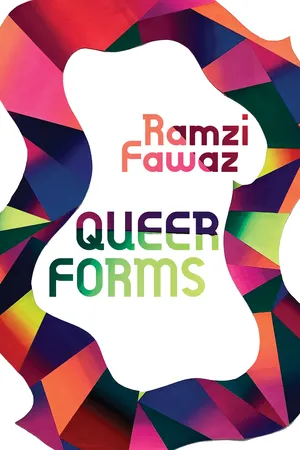
How do we represent the experience of being a gender and sexual outlaw?
In Queer Forms, Ramzi Fawaz explores how the central values of 1970s movements for women's and gay liberation—including consciousness-raising, separatism, and coming out of the closet—were translated into a range of American popular culture forms. Throughout this period, feminist and gay activists fought social and political battles to expand, transform, or wholly explode definitions of so-called "normal" gender and sexuality. In doing so, they inspired artists, writers, and filmmakers to invent new ways of formally representing, or giving shape to, non-normative genders and sexualities. This included placing women, queers, and gender outlaws of all stripes into exhilarating new environments—from the streets of an increasingly gay San Francisco to a post-apocalyptic commune, from an Upper East Side New York City apartment to an all-female version of Earth—and finding new ways to formally render queer genders and sexualities by articulating them to figures, outlines, or icons that could be imagined in the mind's eye and interpreted by diverse publics.
Surprisingly, such creative attempts to represent queer gender and sexuality often appeared in a range of traditional, or seemingly generic, popular forms, including the sequential format of comic strip serials, the stock figures or character-types of science fiction genre, the narrative conventions of film melodrama, and the serialized rhythm of installment fiction. Through studies of queer and feminist film, literature, and visual culture including Mart Crowley's The Boys in the Band (1970), Armistead Maupin's Tales of the City (1976–1983), Lizzy Borden's Born in Flames (1983), and Tony Kushner's Angels in America (1989–1991), Fawaz shows how artists innovated in many popular mediums and genres to make the experience of gender and sexual non-conformity recognizable to mass audiences in the modern United States.
Against the ideal of ceaseless gender and sexual fluidity and attachments to rigidly defined identities, Queer Forms argues for the value of shapeshifting as the imaginative transformation of genders and sexualities across time. By taking many shapes of gender and sexual divergence we can grant one another the opportunity to appear and be perceived as an evolving form, not only to claim our visibility, but to be better understood in all our dimensions.??
eBook - ePub
Queer Forms
About this book
Information
Table of contents
- Cover
- Title Page
- Copyright
- Dedication
- Epigraphs
- Contents
- Introduction: Queer Forms
- 1. Stepford Wives and Female Men: The Radical Equality of Female Replicants
- 2. Entering the Vortex: Breaching the Boundaries of the Lesbian Separatist Frontier in Avant-Garde Science Fiction Film
- 3. “Beware the Hostile Fag”: Acidic Intimacies and the Gay Male Consciousness-Raising Circle in The Boys in the Band
- 4. Queer Love on Barbary Lane: The Serial Experience of Coming Out of the Closet with Armistead Maupin’s Tales of the City
- Color illustrations
- 5. Stripped to the Bone: Sequencing Sexual Pluralism in the Comic Strip Work of Joe Brainard and David Wojnarowicz
- 6. “I Cherish My Bile Duct as Much as Any Other Organ”: Political Disgust and the Digestive Life of AIDS in Tony Kushner’s Angels in America
- Conclusion: “Something Else to Be”: On Friendship’s Queer Forms
- Acknowledgments
- Notes
- Bibliography
- Index
- About the Author
Trusted by 375,005 students
Access to over 1.5 million titles for a fair monthly price.
Study more efficiently using our study tools.
Frequently asked questions
Yes, you can cancel anytime from the Subscription tab in your account settings on the Perlego website. Your subscription will stay active until the end of your current billing period. Learn how to cancel your subscription
No, books cannot be downloaded as external files, such as PDFs, for use outside of Perlego. However, you can download books within the Perlego app for offline reading on mobile or tablet. Learn how to download books offline
Perlego offers two plans: Essential and Complete
- Essential is ideal for learners and professionals who enjoy exploring a wide range of subjects. Access the Essential Library with 800,000+ trusted titles and best-sellers across business, personal growth, and the humanities. Includes unlimited reading time and Standard Read Aloud voice.
- Complete: Perfect for advanced learners and researchers needing full, unrestricted access. Unlock 1.5M+ books across hundreds of subjects, including academic and specialized titles. The Complete Plan also includes advanced features like Premium Read Aloud and Research Assistant.
We are an online textbook subscription service, where you can get access to an entire online library for less than the price of a single book per month. With over 1.5 million books across 990+ topics, we’ve got you covered! Learn about our mission
Look out for the read-aloud symbol on your next book to see if you can listen to it. The read-aloud tool reads text aloud for you, highlighting the text as it is being read. You can pause it, speed it up and slow it down. Learn more about Read Aloud
Yes! You can use the Perlego app on both iOS and Android devices to read anytime, anywhere — even offline. Perfect for commutes or when you’re on the go.
Please note we cannot support devices running on iOS 13 and Android 7 or earlier. Learn more about using the app
Please note we cannot support devices running on iOS 13 and Android 7 or earlier. Learn more about using the app
Yes, you can access Queer Forms by Ramzi Fawaz in PDF and/or ePUB format, as well as other popular books in Social Sciences & Civil Rights in Politics. We have over 1.5 million books available in our catalogue for you to explore.