A comprehensive history of the National Civil Liberties Bureau's role in the anti-war movement during the First World War
World War I, given all the rousing "Over-There" songs and in-the-trenches films it inspired, was, at its outset, surprisingly unpopular with the American public. As opposition increased, Woodrow Wilson's presidential administration became intent on stifling antiwar dissent. Wilson effectively silenced the National Civil Liberties Bureau, forerunner of the American Civil Liberties Union. Presidential candidate Eugene Debs was jailed, and Deb's Socialist Party became a prime target of surveillance operations, both covert and overt. Drastic as these measures were, more draconian measures were to come.
In his absorbing new book, Free Speech and the Suppression of Dissent During World War I, Eric Chester reveals that out of this turmoil came a heated public discussion on the theory of civil liberties – the basic freedoms that are, theoretically, untouchable by any of the three branches of the U.S. government. The famous "clear and present danger" argument of Supreme Court Justice Oliver Wendell Holmes, and the "balance of conflicting interest" theory of law professor Zechariah Chafee, for example, evolved to provide a rationale for courts to act as a limited restraint on autocratic actions of the government. But Chester goes further, to examine an alternative theory: civil liberties exist as absolute rights, rather than being dependent on the specific circumstances of each case. Over the years, the debate about the right to dissent has intensified and become more necessary. This fascinating book explains why, a century after the First World War – and in the era of Trump – we need to know about this.
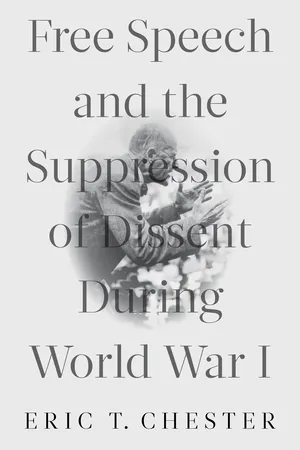
eBook - ePub
Free Speech and the Suppression of Dissent During World War I
- English
- ePUB (mobile friendly)
- Available on iOS & Android
eBook - ePub
Free Speech and the Suppression of Dissent During World War I
About this book
Information
Subtopic
North American HistoryIndex
HistoryTable of contents
- Cover
- Title Page
- Copyright
- Contents
- Acknowledgments
- 1. Introduction
- 2. The British Experience in Suppressing Dissent
- Section I: Civil Liberties and the First World War
- Section II: The Military and the Suppression of Dissent
- Section III: Free Speech and Legal Theory
- Chronology
- Notes
- Glossary
- Bibliography
- Index
Trusted by 375,005 students
Access to over 1.5 million titles for a fair monthly price.
Study more efficiently using our study tools.
Frequently asked questions
Yes, you can cancel anytime from the Subscription tab in your account settings on the Perlego website. Your subscription will stay active until the end of your current billing period. Learn how to cancel your subscription
No, books cannot be downloaded as external files, such as PDFs, for use outside of Perlego. However, you can download books within the Perlego app for offline reading on mobile or tablet. Learn how to download books offline
Perlego offers two plans: Essential and Complete
- Essential is ideal for learners and professionals who enjoy exploring a wide range of subjects. Access the Essential Library with 800,000+ trusted titles and best-sellers across business, personal growth, and the humanities. Includes unlimited reading time and Standard Read Aloud voice.
- Complete: Perfect for advanced learners and researchers needing full, unrestricted access. Unlock 1.5M+ books across hundreds of subjects, including academic and specialized titles. The Complete Plan also includes advanced features like Premium Read Aloud and Research Assistant.
We are an online textbook subscription service, where you can get access to an entire online library for less than the price of a single book per month. With over 1.5 million books across 990+ topics, we’ve got you covered! Learn about our mission
Look out for the read-aloud symbol on your next book to see if you can listen to it. The read-aloud tool reads text aloud for you, highlighting the text as it is being read. You can pause it, speed it up and slow it down. Learn more about Read Aloud
Yes! You can use the Perlego app on both iOS and Android devices to read anytime, anywhere — even offline. Perfect for commutes or when you’re on the go.
Please note we cannot support devices running on iOS 13 and Android 7 or earlier. Learn more about using the app
Please note we cannot support devices running on iOS 13 and Android 7 or earlier. Learn more about using the app
Yes, you can access Free Speech and the Suppression of Dissent During World War I by Eric Thomas Chester,Eric T. Chester in PDF and/or ePUB format, as well as other popular books in History & North American History. We have over 1.5 million books available in our catalogue for you to explore.