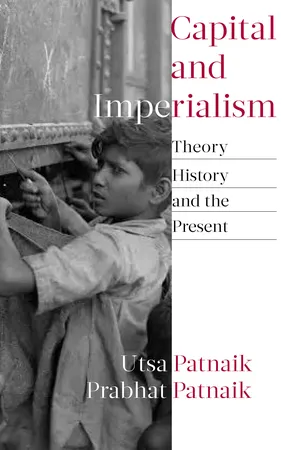
A comprehensive survey of capitalism's colonialist roots and uncertain future
Those who control the world's commanding economic heights, buttressed by the theories of
mainstream economists, presume that capitalism is a self-contained and self-generating system.
Nothing could be further from the truth. In this pathbreaking book—winner of the Paul A. Baran-Paul M.
Sweezy Memorial Award—radical political economists Utsa Patnaik and Prabhat Patnaik argue that the
accumulation of capital has always required the taking of land, raw materials, and bodies from
noncapitalist modes of production. They begin with a thorough debunking of mainstream economics.
Then, looking at the history of capitalism, from the beginnings of colonialism half a millennium ago to
today's neoliberal regimes, they discover that, over the long haul, capitalism, in order to exist, must
metastasize itself in the practice of imperialism and the immiseration of countless people.
A few hundred years ago, write the Patnaiks, colonialism began to ensure vast, virtually free, markets for
new products in burgeoning cities in the West. But even after slavery was generally abolished, millions
of people in the Global South still fell prey to the continuing lethal exigencies of the marketplace. Even
after the Second World War, when decolonization led to the end of the so-called "Golden Age of
Capitalism," neoliberal economies stepped in to reclaim the Global South, imposing drastic "austerity"
measures on working people. But, say the Patnaiks, this neoliberal economy, which lives from bubble to
bubble, is doomed to a protracted crisis. In its demise, we are beginning to see – finally – the
transcendence of the capitalist system.
- English
- ePUB (mobile friendly)
- Available on iOS & Android
eBook - ePub
About this book
Information
Table of contents
- Cover
- Title Page
- Copyright
- Dedication
- Contents
- Preface
- Part 1
- Part 2
- Part 3
- Part 4
- Part 5
- Part 6
- Notes
- Index
Trusted by 375,005 students
Access to over 1.5 million titles for a fair monthly price.
Study more efficiently using our study tools.
Frequently asked questions
Yes, you can cancel anytime from the Subscription tab in your account settings on the Perlego website. Your subscription will stay active until the end of your current billing period. Learn how to cancel your subscription
No, books cannot be downloaded as external files, such as PDFs, for use outside of Perlego. However, you can download books within the Perlego app for offline reading on mobile or tablet. Learn how to download books offline
Perlego offers two plans: Essential and Complete
- Essential is ideal for learners and professionals who enjoy exploring a wide range of subjects. Access the Essential Library with 800,000+ trusted titles and best-sellers across business, personal growth, and the humanities. Includes unlimited reading time and Standard Read Aloud voice.
- Complete: Perfect for advanced learners and researchers needing full, unrestricted access. Unlock 1.5M+ books across hundreds of subjects, including academic and specialized titles. The Complete Plan also includes advanced features like Premium Read Aloud and Research Assistant.
We are an online textbook subscription service, where you can get access to an entire online library for less than the price of a single book per month. With over 1.5 million books across 990+ topics, we’ve got you covered! Learn about our mission
Look out for the read-aloud symbol on your next book to see if you can listen to it. The read-aloud tool reads text aloud for you, highlighting the text as it is being read. You can pause it, speed it up and slow it down. Learn more about Read Aloud
Yes! You can use the Perlego app on both iOS and Android devices to read anytime, anywhere — even offline. Perfect for commutes or when you’re on the go.
Please note we cannot support devices running on iOS 13 and Android 7 or earlier. Learn more about using the app
Please note we cannot support devices running on iOS 13 and Android 7 or earlier. Learn more about using the app
Yes, you can access Capital and Imperialism by Utsa Patnaik,Prabhat Patnaik in PDF and/or ePUB format, as well as other popular books in Politics & International Relations & Political History & Theory. We have over 1.5 million books available in our catalogue for you to explore.