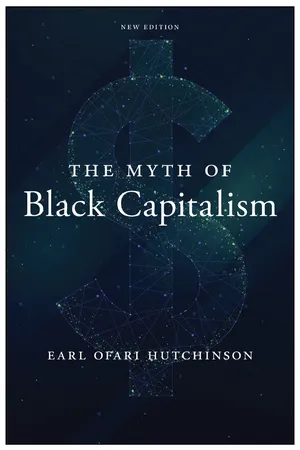
Deciphers the history of "Black capitalist" rhetoric— and how it serves to enrich a minuscule few at the expense of the many
In his 1970 book The Myth of Black Capitalism, Earl Ofari Hutchinson laid out a rigorous challenge to the presumption that capitalism, in any shape or form, has the potential to rectify the stark injustices endured by Black people in America. Ofari engaged in a diligent historical review of the participation of African Americans in commercial activity in this capitalist country, demonstrating conclusively that the creation of a class of Black capitalists failed to ameliorate the extreme inequity faced by African Americans. Even "Buy Black" campaigns which aimed to "keep resources in the community," he showed, reinforced a Black bourgeoisie which often enough exploited the Black underclass to increase their own wealth. Whether Black capitalists dared to go up against, or merely tried to find their place amongst, giant monopoly corporations, Ofari argued they would make little substantive progress in the lives of Black people. And whether calls for "Black capitalism" came from within the Black Power movement for Black economic autonomy, or were appropriated by the old-line Black elite, in the end the promotion of the myth of "Black capitalism" was a project of the Black elite which solely served the interests of the capitalist managerial class.
It was Richard Nixon who first introduced the notion of "Black capitalism" into mainstream American discourse, coopting the term at a time when African Americans comprised only 3% of the nation's employers. That number dwindled thereafter, and yet the term only gained cachet following the election of Barack Obama and the increased visibility of the Black elite. Thankfully, just as the rhetoric of 'Black capitalism" is being resuscitated, it is being confronted once more. In this second edition of Earl Ofari's pathbreaking book, a Monthly Review Press classic, the author adds a new Introduction, which shows both the enduring strength of the ideology of Black capitalism and its continued inability to change the nature of what has always been a racialized system of production and distribution. Ofari reveals "Black capitalism" for what it really is: a diversion from the struggle for liberation that works at cross purposes with the fight against exploitation, and a fantasy which enriches a minuscule few at the expense of the many. The Myth of Black Capitalism argues definitively that only a direct assault on the oppression of Black people and the capitalist system itself can bring this exploitation to an end.
- English
- ePUB (mobile friendly)
- Available on iOS & Android
eBook - ePub
About this book
Information
Subtopic
Business GeneralTable of contents
- Cover
- About the Author
- Title Page
- Copyright
- Contents
- Introduction to the New Edition: Is Black Capitalism Still a Myth?
- Epigraphs
- Introduction to the First Edition
- 1. The Origin of the Legacy
- 2. Black Religion and Capitalism
- 3. Whose Capitalism?
- 4. Black Capitalism’s Other Faces
- 5. And What of Africa?
- Conclusion
- Bibliography
- Notes
- Index
Trusted by 375,005 students
Access to over 1.5 million titles for a fair monthly price.
Study more efficiently using our study tools.
Frequently asked questions
Yes, you can cancel anytime from the Subscription tab in your account settings on the Perlego website. Your subscription will stay active until the end of your current billing period. Learn how to cancel your subscription
No, books cannot be downloaded as external files, such as PDFs, for use outside of Perlego. However, you can download books within the Perlego app for offline reading on mobile or tablet. Learn how to download books offline
Perlego offers two plans: Essential and Complete
- Essential is ideal for learners and professionals who enjoy exploring a wide range of subjects. Access the Essential Library with 800,000+ trusted titles and best-sellers across business, personal growth, and the humanities. Includes unlimited reading time and Standard Read Aloud voice.
- Complete: Perfect for advanced learners and researchers needing full, unrestricted access. Unlock 1.5M+ books across hundreds of subjects, including academic and specialized titles. The Complete Plan also includes advanced features like Premium Read Aloud and Research Assistant.
We are an online textbook subscription service, where you can get access to an entire online library for less than the price of a single book per month. With over 1.5 million books across 990+ topics, we’ve got you covered! Learn about our mission
Look out for the read-aloud symbol on your next book to see if you can listen to it. The read-aloud tool reads text aloud for you, highlighting the text as it is being read. You can pause it, speed it up and slow it down. Learn more about Read Aloud
Yes! You can use the Perlego app on both iOS and Android devices to read anytime, anywhere — even offline. Perfect for commutes or when you’re on the go.
Please note we cannot support devices running on iOS 13 and Android 7 or earlier. Learn more about using the app
Please note we cannot support devices running on iOS 13 and Android 7 or earlier. Learn more about using the app
Yes, you can access The Myth of Black Capitalism by Earl Ofari Hutchinson in PDF and/or ePUB format, as well as other popular books in Politics & International Relations & Business General. We have over 1.5 million books available in our catalogue for you to explore.