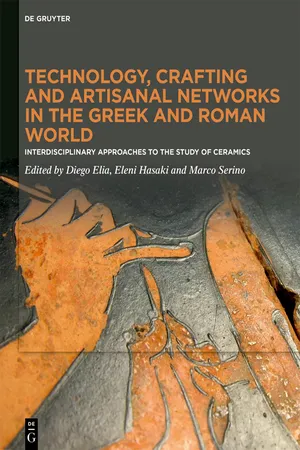
Technology, Crafting and Artisanal Networks in the Greek and Roman World
eBook - ePub

Technology, Crafting and Artisanal Networks in the Greek and Roman World

Interdisciplinary Approaches to the Study of Ceramics

  1. 394 pages
  2. English
  3. ePUB (mobile friendly)
  4. Available on iOS & Android
eBook - ePub

Technology, Crafting and Artisanal Networks in the Greek and Roman World

Interdisciplinary Approaches to the Study of Ceramics

About this book

This volume aims to merge theoretical models with methodological approaches on ceramic technology and artisanal networks in the Classical world. This convergence of analytical frameworks allowed scholars to explore some traditional archaeological topics that usually have a very low-level of visibility, such as the skillful gestures of the craftspeople involved, the organization of the ceramic production, the dynamics of apprenticeship and knowledge transfer as well as intra and inter-regional artisanal mobility, in the Graeco-Roman 'communities of practice'.

The papers promote interdisciplinary dialogues among various fields of study, such as archaeology, archaeometry, anthropology, ethnoarchaeology, experimental archaeology, and digital humanities - such as Social Network Analysis, computational imaging, and big data analysis.

Frequently asked questions

Yes, you can cancel anytime from the Subscription tab in your account settings on the Perlego website. Your subscription will stay active until the end of your current billing period. Learn how to cancel your subscription.
At the moment all of our mobile-responsive ePub books are available to download via the app. Most of our PDFs are also available to download and we're working on making the final remaining ones downloadable now. Learn more here.
Perlego offers two plans: Essential and Complete
  • Essential is ideal for learners and professionals who enjoy exploring a wide range of subjects. Access the Essential Library with 800,000+ trusted titles and best-sellers across business, personal growth, and the humanities. Includes unlimited reading time and Standard Read Aloud voice.
  • Complete: Perfect for advanced learners and researchers needing full, unrestricted access. Unlock 1.4M+ books across hundreds of subjects, including academic and specialized titles. The Complete Plan also includes advanced features like Premium Read Aloud and Research Assistant.
Both plans are available with monthly, semester, or annual billing cycles.
We are an online textbook subscription service, where you can get access to an entire online library for less than the price of a single book per month. With over 1 million books across 1000+ topics, we’ve got you covered! Learn more here.
Look out for the read-aloud symbol on your next book to see if you can listen to it. The read-aloud tool reads text aloud for you, highlighting the text as it is being read. You can pause it, speed it up and slow it down. Learn more here.
Yes! You can use the Perlego app on both iOS or Android devices to read anytime, anywhere — even offline. Perfect for commutes or when you’re on the go.
Please note we cannot support devices running on iOS 13 and Android 7 or earlier. Learn more about using the app.
Yes, you can access Technology, Crafting and Artisanal Networks in the Greek and Roman World by Diego Elia,Eleni Hasaki,Marco Serino in PDF and/or ePUB format, as well as other popular books in History & Ancient History. We have over one million books available in our catalogue for you to explore.

Information

Publisher
De Gruyter
Year
2024
eBook ISBN
9783111190587
Edition
0

Table of contents

  1. Title Page
  2. Copyright
  3. Contents
  4. Editorial Board
  5. Introduction
  6. Section I: The Shapes of Clay: Manufacturing and Local Traditions
  7. Section II: Populating the Ancient Pottery Industry
  8. Section III: Workshop Recipies and Craft Production Systems: Technologies Magnified
  9. Section IV: From Invisible to Visible: Artisanal Gestures, Ontologies, and Ceramic Networks
  10. Section V: Craftspeople’s Mobility and Knowledge Transfer: Distribution and Statistics
  11. Epilogue