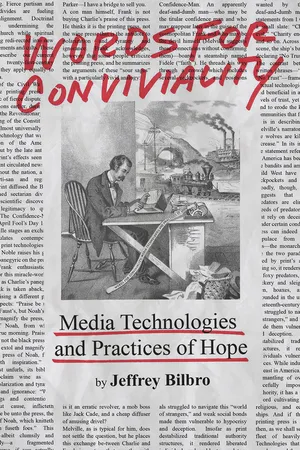
Words for Conviviality
eBook - PDF

Words for Conviviality

Media Technologies and Practices of Hope

  1. 312 pages
  2. English
  3. PDF
  4. Available on iOS & Android
eBook - PDF

Words for Conviviality

Media Technologies and Practices of Hope

About this book

The industrialization of print technologies in early nineteenth-century America transformed print culture in ways that parallel the transformation wrought by the digital revolution. Understanding how a previous era was shaped by the assumptions print technology engendered may enable us to recognize more clearly how our verbal habits and practices are formed and deformed by our enmeshment in digital technologies.

When powerful new verbal media come along, our options are not limited to naive optimism or resigned pessimism. And some of the most helpful guides in charting a path toward genuinely convivial modes of reading are the literary authors who lived through the antebellum industrialization of print. Those authors sought to understand the effects of technologies such as the telegraph and the steam-powered rotary printing press through the most fundamental tool that language provides: metaphor. Evocative metaphors are a potent way to raise cultural awareness regarding the hidden affordances and subtle nudges that are latent within dominant communications technologies.

The argument of Words for Conviviality follows a pilgrimage with three stages and considers a set of metaphors that such authors deployed to answer three underlying questions: What does industrial print tempt optimistic readers to imagine themselves as? What does it lead its victims to fear they will become? And what alternative metaphors might ground more convivial reading? The metaphors of hope that Jeffrey Bilbro discusses suggest that to wield textual technologies well, we need to develop cultural practices and institutions that strengthen our relationships with one another and our commitment to a common good. Instead of developing new technologies to solve the problems that technologies have caused, the authors considered here propose developing better readers--readers more attuned to the power of the textual technologies they use and better able to imagine and practice healthy, convivial forms of discourse. These authors obviously did not eschew industrialized print, and they did not simply give up on the technologies of their day. Rather, they developed metaphors that might inspire us to beat textual swords into plowshares.

Frequently asked questions

Yes, you can cancel anytime from the Subscription tab in your account settings on the Perlego website. Your subscription will stay active until the end of your current billing period. Learn how to cancel your subscription.
No, books cannot be downloaded as external files, such as PDFs, for use outside of Perlego. However, you can download books within the Perlego app for offline reading on mobile or tablet. Learn more here.
Perlego offers two plans: Essential and Complete
  • Essential is ideal for learners and professionals who enjoy exploring a wide range of subjects. Access the Essential Library with 800,000+ trusted titles and best-sellers across business, personal growth, and the humanities. Includes unlimited reading time and Standard Read Aloud voice.
  • Complete: Perfect for advanced learners and researchers needing full, unrestricted access. Unlock 1.4M+ books across hundreds of subjects, including academic and specialized titles. The Complete Plan also includes advanced features like Premium Read Aloud and Research Assistant.
Both plans are available with monthly, semester, or annual billing cycles.
We are an online textbook subscription service, where you can get access to an entire online library for less than the price of a single book per month. With over 1 million books across 1000+ topics, we’ve got you covered! Learn more here.
Look out for the read-aloud symbol on your next book to see if you can listen to it. The read-aloud tool reads text aloud for you, highlighting the text as it is being read. You can pause it, speed it up and slow it down. Learn more here.
Yes! You can use the Perlego app on both iOS or Android devices to read anytime, anywhere — even offline. Perfect for commutes or when you’re on the go.
Please note we cannot support devices running on iOS 13 and Android 7 or earlier. Learn more about using the app.
Yes, you can access Words for Conviviality by Jeffrey Bilbro in PDF and/or ePUB format, as well as other popular books in Theology & Religion & North American History. We have over one million books available in our catalogue for you to explore.

Table of contents

  1. Cover
  2. Half Title Page, Title Page, Copyright Page, Dedication
  3. Contents
  4. Acknowledgments
  5. List of Images
  6. Introduction: Trust, Watersheds, and America’s Industrial Print Culture
  7. Twenty-Six Theses on Textual Technologies
  8. I: Utopia: Or, What does industrial print tempt optimistic readers to imagine themselves as?
  9. 1. Transparent Eyeballs
  10. 2. Men of Adamant
  11. 3. Encyclopedists and Map-Plotters
  12. 4. Celebrities
  13. 5. Benevolent Bosses
  14. II: Dystopia: Or, What does industrial print lead its victims to fear they will become?
  15. 6. Loose Fish
  16. 7. Macadamized Minds
  17. 8. Commodities
  18. 9. Slaves
  19. III: Hope: Or, What alternative metaphors might orient more convivial reading?
  20. 10. Walkers
  21. 11. Conversationalists
  22. 12. Friends
  23. 13. Cross-Bearers
  24. Epilogue
  25. Notes
  26. Bibliography
  27. Index