Tenacious activism by Quakers, African Americans, and antislavery evangelicals made antislavery central to the American Revolution
In Let the Oppressed Go Free, Nicholas P. Wood presents the opponents of slavery who sustained and expanded the antislavery movement during the American Revolution in the face of widespread hostility. These early abolitionists were inspired by antislavery theology: the view that slavery was a sinful form of oppression that would provoke God's wrath against slaveholding societies. These principles were first advanced by a handful of Quakers and Puritans as early as the 1600s, but they did not become widespread until the second half of the eighteenth century. Quakers embraced antislavery theology during the French and Indian War, which they interpreted as divine chastisement for the sin of colonial slavery. Citing the prophet Isaiah, they pledged to please the Lord by letting the oppressed go free.
Antislavery theology became even more prominent during the American Revolution. When Parliament provoked an imperial crisis in the 1760s, abolitionists argued it was further evidence of God's anger over slavery. The outbreak of war in 1775 made these arguments increasingly persuasive. Let the Oppressed Go Free demonstrates that antislavery activism during the Revolution by Quakers, African Americans, and evangelical patriots was more sophisticated and influential than historians have recognized. The northern states that began abolishing slavery during the Revolution did so in response to tenacious agitation and generally described their actions as designed to earn God's blessing.
Let the Oppressed Go Free challenges many common assumptions about abolitionism and the American Revolution. Wood demonstrates that religion remained central to abolitionism rather than being displaced by "secular" arguments about natural rights. And whereas some have argued that the Revolutionary War hindered antislavery progress and fueled racism, Wood shows that the war accelerated reform.
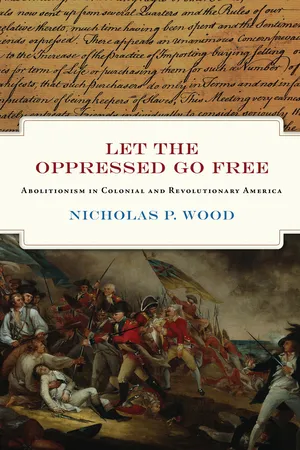
eBook - ePub
Let the Oppressed Go Free
Abolitionism in Colonial and Revolutionary America
- 400 pages
- English
- ePUB (mobile friendly)
- Available on iOS & Android
eBook - ePub
Let the Oppressed Go Free
Abolitionism in Colonial and Revolutionary America
About this book
Information
Subtopic
Early American HistoryIndex
HistoryTable of contents
- Cover
- Series Page
- Title Page
- Copyright
- Dedication
- Epigraph
- Contents
- Introduction
- Chapter 1. The Biblical Basis of Slavery and Antislavery in Colonial North America
- Chapter 2. Antislavery Providentialism During the French and Indian War
- Chapter 3. Abolitionism and the Imperial Crisis, Part I: 1764–1772
- Chapter 4. Abolitionism and the Imperial Crisis, Part II: 1772–1775
- Chapter 5. Wartime Antislavery Ideology and Activism, 1775–1779
- Chapter 6. Antislavery Reform During the Revolutionary War, 1778–1783
- Chapter 7. The Critical Period of Abolitionism, 1783–1789
- Epilogue
- List of Abbreviations
- Notes
- Index
- Acknowledgments
Trusted by 375,005 students
Access to over 1.5 million titles for a fair monthly price.
Study more efficiently using our study tools.
Frequently asked questions
Yes, you can cancel anytime from the Subscription tab in your account settings on the Perlego website. Your subscription will stay active until the end of your current billing period. Learn how to cancel your subscription
No, books cannot be downloaded as external files, such as PDFs, for use outside of Perlego. However, you can download books within the Perlego app for offline reading on mobile or tablet. Learn how to download books offline
Perlego offers two plans: Essential and Complete
- Essential is ideal for learners and professionals who enjoy exploring a wide range of subjects. Access the Essential Library with 800,000+ trusted titles and best-sellers across business, personal growth, and the humanities. Includes unlimited reading time and Standard Read Aloud voice.
- Complete: Perfect for advanced learners and researchers needing full, unrestricted access. Unlock 1.5M+ books across hundreds of subjects, including academic and specialized titles. The Complete Plan also includes advanced features like Premium Read Aloud and Research Assistant.
We are an online textbook subscription service, where you can get access to an entire online library for less than the price of a single book per month. With over 1.5 million books across 990+ topics, we’ve got you covered! Learn about our mission
Look out for the read-aloud symbol on your next book to see if you can listen to it. The read-aloud tool reads text aloud for you, highlighting the text as it is being read. You can pause it, speed it up and slow it down. Learn more about Read Aloud
Yes! You can use the Perlego app on both iOS and Android devices to read anytime, anywhere — even offline. Perfect for commutes or when you’re on the go.
Please note we cannot support devices running on iOS 13 and Android 7 or earlier. Learn more about using the app
Please note we cannot support devices running on iOS 13 and Android 7 or earlier. Learn more about using the app
Yes, you can access Let the Oppressed Go Free by Nicholas Wood,Nicholas P. Wood in PDF and/or ePUB format, as well as other popular books in History & Early American History. We have over 1.5 million books available in our catalogue for you to explore.