- 594 pages
- English
- ePUB (mobile friendly)
- Available on iOS & Android
About this book
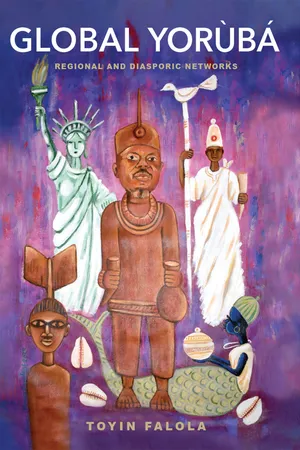
In Global Yorùbá, renowned scholar Toyin Falola covers the history, people, traditions, environment, religion, spirituality, cosmology, culture, and philosophy of one of Africa's largest cultural groups, the Yorùbá, all while considering the people's relationship with their immediate and distant neighbors.
Falola examines how the Yorùbán people have adapted to their environment and tapped it to (re)invent their civilization, shape their culture and traditions, and inform their socioeconomic relations with their neighbors. These interactions have guided the Yorùbá philosophy that developed over time, expressing their conviction regarding society's evolution and the place that humans occupy within it. This web of knowledge can present a more coherent account than any other text yet produced regarding Yorùbá civilization.
This volume demonstrates how global dynamics have been adopted in the creation of a Yorùbá community across different times and spaces.
Frequently asked questions
- Essential is ideal for learners and professionals who enjoy exploring a wide range of subjects. Access the Essential Library with 800,000+ trusted titles and best-sellers across business, personal growth, and the humanities. Includes unlimited reading time and Standard Read Aloud voice.
- Complete: Perfect for advanced learners and researchers needing full, unrestricted access. Unlock 1.4M+ books across hundreds of subjects, including academic and specialized titles. The Complete Plan also includes advanced features like Premium Read Aloud and Research Assistant.
Please note we cannot support devices running on iOS 13 and Android 7 or earlier. Learn more about using the app.
Information
Table of contents
- Cover
- Half-Title Page
- Title Page
- Copyright
- Dedication
- Contents
- Maps
- Preface
- Acknowledgments
- Introduction
- Part 1: Pan-Yorubana
- Part 2: The Yorùbá in the World of Religion
- Part 3: Modernity, Postcoloniality, and Globalization
- Conclusion
- Bibliography
- Index
- About the Author