A New Imperial History of Northern Eurasia, 1700-1918 proposes a new language for studying and conceptualizing the spaces, societies, and institutions that existed on the territory of today's Northern Eurasia, until recently part of the USSR. Traditional concepts and genealogies that frame human experience have to be avoided or reframed: this is not the story of a certain present-day state or people evolving through consecutive historical stages. Rather, the book's point of departure is a modern analytical approach to the problem of human diversity as a fundamental social condition. In the form of cooperation and confrontation, various attempts to manage diversity fostered processes of societal self-organization, as new ideas, practices, and institutions were developed virtually from scratch or radically altered when borrowed. Essentially, this is the story of individuals and societies who creatively responded to their natural and social environments and sought answers to universal problems in unique historical circumstances.
This volume, which brings together leading scholars from the United States and Russia, covers the period during which the enormous landmass from the Carpathian Mountains in the west to the Pacific Ocean in the east, from the Polar Circle in the north to the steppe belt in the south was put under the control of a single polity: the Russian Empire. Previously, the competing local scenarios of self-organization had taken specific political forms that suited them best. This book shows that the Russian Empire faced the daunting task of coordinating multifaceted diversity within a single political and legal body, under constantly changing domestic and international circumstances. The study reveals that, to this end, the imperial regime employed various means, from violence to science, from segregation to integration, and yet was still unable to block multiple political actors within the empire from advancing their own strategies of belonging, resistance, and participation.
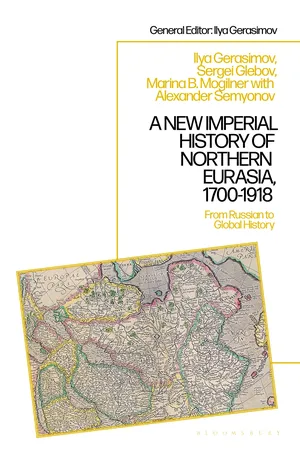
eBook - ePub
A New Imperial History of Northern Eurasia, 1700-1918
From Russian to Global History
- 499 pages
- English
- ePUB (mobile friendly)
- Available on iOS & Android
eBook - ePub
A New Imperial History of Northern Eurasia, 1700-1918
From Russian to Global History
About this book
Information
Table of contents
- Cover
- Half Title
- Title Page
- Table of Contents
- Note on the Text
- Introduction: Modern Society’s Imperial Situation
- 8 From the “Gunpowder Empire” to the “Modern State”
- 9 From the “Modern State” to the “Modern Empire”
- 10 The Modern Empire in Search of a Nation
- 11 Designing a National Empire
- 12 Empire and Revolution: The Revolutionary Movement in Imperial Society before the Era of Mass Politics
- 13 The Collapse of the Rusian National Empire Regime
- 14 Self-Organization of the “Progressive Empire”
- 15 The War of Globalization and the Imperial Revolution
- Index
- Copyright Page
Trusted by 375,005 students
Access to over 1.5 million titles for a fair monthly price.
Study more efficiently using our study tools.
Frequently asked questions
Yes, you can cancel anytime from the Subscription tab in your account settings on the Perlego website. Your subscription will stay active until the end of your current billing period. Learn how to cancel your subscription
No, books cannot be downloaded as external files, such as PDFs, for use outside of Perlego. However, you can download books within the Perlego app for offline reading on mobile or tablet. Learn how to download books offline
Perlego offers two plans: Essential and Complete
- Essential is ideal for learners and professionals who enjoy exploring a wide range of subjects. Access the Essential Library with 800,000+ trusted titles and best-sellers across business, personal growth, and the humanities. Includes unlimited reading time and Standard Read Aloud voice.
- Complete: Perfect for advanced learners and researchers needing full, unrestricted access. Unlock 1.5M+ books across hundreds of subjects, including academic and specialized titles. The Complete Plan also includes advanced features like Premium Read Aloud and Research Assistant.
We are an online textbook subscription service, where you can get access to an entire online library for less than the price of a single book per month. With over 1.5 million books across 990+ topics, we’ve got you covered! Learn about our mission
Look out for the read-aloud symbol on your next book to see if you can listen to it. The read-aloud tool reads text aloud for you, highlighting the text as it is being read. You can pause it, speed it up and slow it down. Learn more about Read Aloud
Yes! You can use the Perlego app on both iOS and Android devices to read anytime, anywhere — even offline. Perfect for commutes or when you’re on the go.
Please note we cannot support devices running on iOS 13 and Android 7 or earlier. Learn more about using the app
Please note we cannot support devices running on iOS 13 and Android 7 or earlier. Learn more about using the app
Yes, you can access A New Imperial History of Northern Eurasia, 1700-1918 by Marina B. Mogilner,Alexander Semyonov,Ilya V. Gerasimov,Sergey Glebov in PDF and/or ePUB format, as well as other popular books in History & Modern History. We have over 1.5 million books available in our catalogue for you to explore.