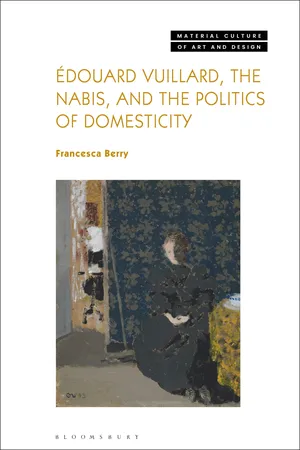
This ground-breaking book is the first to address the feminine and feminist politics of Intimiste art - a modernist mode of art making developed in the 1890s by Édouard Vuillard while associated with the Nabi 'brotherhood'.
Coined by contemporary critics, 'intimisme' encapsulated the shared approach of these artists to depicting intimate settings and themes. Vuillard's paintings, which are typically small, employ bold pigments and economic brushstrokes to depict female figures in tightly composed apartment interiors. Those portrayed include his mother and sister, just as wives and lovers dominate the art of other Nabis, including Maurice Denis and Pierre Bonnard.
Francesca Berry comparatively analyses the gender politics of Nabi art to reveal real differences. Through skilled visual interpretation she argues that Vuillard attempted a profound engagement with the material conditions of feminine domesticity in cooperation with his first and most sustained audience: women. He did so, the author reveals, in artworks that explore a complex range of feminine experiences such as sexual initiation, stillbirth, illicit work, and unceasing housework. The personal gender politics of Intimiste practice also are foregrounded. Vuillard's studio-bedroom afforded him access to quotidian femininity. But at what risks to his sister's privacy and to his mother's subjectivity?
Making an artistic project of feminine domesticity also meant entering the field of politics. The 1890s was the decade of state legislation and feminist demands with respect to work in the home and women's familial rights. Personal in motif and Symbolist in form, Berry's extensive historical research reveals these artworks also to have been social and political, sometimes even feminist, in meaning. Transcending the structural repression of domesticity in histories of modernist art, this book powerfully overturns residual myths of aesthetic introspection and social retreat that for too long have been attached to Nabi Symbolism.
- 275 pages
- English
- ePUB (mobile friendly)
- Available on iOS & Android
eBook - ePub
Édouard Vuillard, the Nabis, and the Politics of Domesticity
About this book
Information
Topic
ArtSubtopic
Artist MonographsTable of contents
- Cover
- Half-Title Page
- Series Page
- Title Page
- Contents
- List of Illustrations
- Acknowledgements
- Note on Translations
- Abbreviations
- Introduction
- 1 Intimisme and the Critical Politics of Domesticity
- 2 Atelier-Chambre and Chambre: The Sexual Politics of Intimiste Space
- 3 Maman: Muse and Motif
- 4 Seeing and Sewing: The Family Business
- 5 Brush and Broom: Housework as Art Work
- Conclusion
- Notes
- Bibliography
- Index
- Plates
- Copyright
Trusted by 375,005 students
Access to over 1.5 million titles for a fair monthly price.
Study more efficiently using our study tools.
Frequently asked questions
Yes, you can cancel anytime from the Subscription tab in your account settings on the Perlego website. Your subscription will stay active until the end of your current billing period. Learn how to cancel your subscription
No, books cannot be downloaded as external files, such as PDFs, for use outside of Perlego. However, you can download books within the Perlego app for offline reading on mobile or tablet. Learn how to download books offline
Perlego offers two plans: Essential and Complete
- Essential is ideal for learners and professionals who enjoy exploring a wide range of subjects. Access the Essential Library with 800,000+ trusted titles and best-sellers across business, personal growth, and the humanities. Includes unlimited reading time and Standard Read Aloud voice.
- Complete: Perfect for advanced learners and researchers needing full, unrestricted access. Unlock 1.5M+ books across hundreds of subjects, including academic and specialized titles. The Complete Plan also includes advanced features like Premium Read Aloud and Research Assistant.
We are an online textbook subscription service, where you can get access to an entire online library for less than the price of a single book per month. With over 1.5 million books across 990+ topics, we’ve got you covered! Learn about our mission
Look out for the read-aloud symbol on your next book to see if you can listen to it. The read-aloud tool reads text aloud for you, highlighting the text as it is being read. You can pause it, speed it up and slow it down. Learn more about Read Aloud
Yes! You can use the Perlego app on both iOS and Android devices to read anytime, anywhere — even offline. Perfect for commutes or when you’re on the go.
Please note we cannot support devices running on iOS 13 and Android 7 or earlier. Learn more about using the app
Please note we cannot support devices running on iOS 13 and Android 7 or earlier. Learn more about using the app
Yes, you can access Édouard Vuillard, the Nabis, and the Politics of Domesticity by Francesca Berry in PDF and/or ePUB format, as well as other popular books in Art & Artist Monographs. We have over 1.5 million books available in our catalogue for you to explore.