WINNER Pierre Savard Award, International Council for Canadian Studies (2026)
WINNER Governor General's History Award for Scholarly Research (2025)
WINNER Best Book in Canadian Studies Prize, Canadian Studies Network (2025)
WINNER Best First Book - Native American and Indigenous Studies Association (2025)
WINNER CLIO History Prize (North), Canadian Historical Association (2025)
WINNER Best Scholarly (English-Language) Book in Canadian History Prize, Canadian Historical Association (2025)
SHORT-LISTED Indigenous History Book Prize, Canadian Historical Association (2025)
SHORT-LISTED J.W. Dafoe Book Prize (2025)
SHORT-LISTED Robert Kroetsch - City of Edmonton Book Prize (2025)
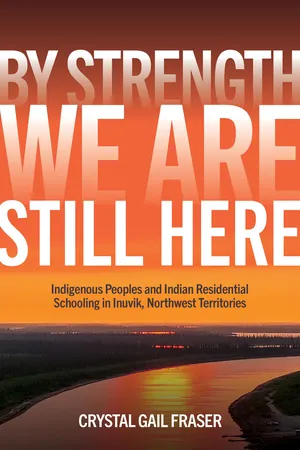
The first comprehensive study of Indian residential schools in the North
In this ground-breaking book, Crystal Gail Fraser draws on Dinjii Zhuh (Gwich'in) concepts of individual and collective strength to illuminate student experiences in northern residential schools, revealing the many ways Indigenous communities resisted the institutionalization of their children.
After 1945, federal bureaucrats and politicians increasingly sought to assimilate Indigenous northerners—who had remained comparatively outside of their control—into broader Canadian society through policies that were designed to destroy Indigenous ways of life. Foremost among these was an aggressive new schooling policy that mandated the construction of Grollier and Stringer Halls: massive residential schools that opened in Inuvik in 1959, eleven years after a special joint committee of the House of Commons and the Senate recommended that all residential schools in Canada be closed.
By Strength, We Are Still Here shares the lived experiences of Indigenous northerners from 1959 until 1982, when the territorial government published a comprehensive plan for educational reform. Led by Survivor testimony, Fraser shows the roles both students and their families played in disrupting state agendas, including questioning and changing the system to protect their cultures and communities.
Centring the expertise of Knowledge Keepers, By Strength, We Are Still Here makes a crucial contribution to Indigenous research methodologies and to understandings of Canadian and Indigenous histories during the second half of the twentieth century.