Our age – saturated with media images and ever-present political crises – traces back to the beginning of Christianity and its messianic vision of the world. In the twentieth and twenty-first centuries, our sense of time and history has become apocalyptic.
In The Illegitimate Age Federico Vercellone explains contemporary affinities for both apocalypse and media imagery from the perspective of political theology, drawing from St Paul's mysterious figure of the katechon – the withholding power that prevents the arrival of the Antichrist and the end of times while also delaying the Messiah, therefore containing the very evil it restrains. Vercellone highlights representation as a crucial aspect of the katechon myth, finding within it the roots of current political and aesthetic forms. In the context of contemporary populism, charismatic leaders build their power on presumed prestige, mimicry of sacred figures, and pandering invocations of kitsch, all recurrent aspects of the katechon and Antichrist trope in Western art and history. Political power, Vercellone argues, has been deeply aestheticized, and the path that led us here was laid long before mass media, mass consumption, and our society of the spectacle.
A new interpretation of the political and aesthetic categories first suggested by Carl Schmitt, Walter Benjamin, and Jean Baudrillard, The Illegitimate Age turns a fresh lens on the legitimacy of political power, the appeal of populism, and the role of the image in our society.
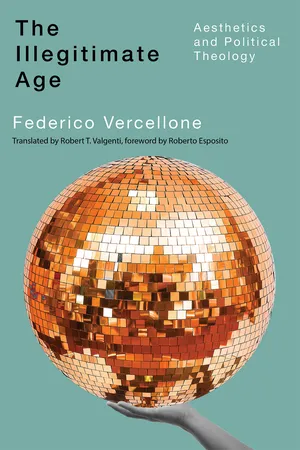
eBook - ePub
The Illegitimate Age
Aesthetics and Political Theology
- 152 pages
- English
- ePUB (mobile friendly)
- Available on iOS & Android
eBook - ePub
About this book
Information
Topic
PhilosophySubtopic
Aesthetics in PhilosophyTable of contents
- Cover
- Halftitle
- Series Page
- Title Page
- Copyright Page
- Contents
- Foreword
- Acknowledgments
- Introduction
- 1 The Anti-Utopian Age
- 2 The Aestheticization of Power: More on “The Withholding Power”
- 4 From Dostoevsky to Today
- 5 Still in the Christian Era
- 6 The Aesthetics of “The Withholding Power”
- Notes
- Index
Trusted by 375,005 students
Access to over 1.5 million titles for a fair monthly price.
Study more efficiently using our study tools.
Frequently asked questions
Yes, you can cancel anytime from the Subscription tab in your account settings on the Perlego website. Your subscription will stay active until the end of your current billing period. Learn how to cancel your subscription
No, books cannot be downloaded as external files, such as PDFs, for use outside of Perlego. However, you can download books within the Perlego app for offline reading on mobile or tablet. Learn how to download books offline
Perlego offers two plans: Essential and Complete
- Essential is ideal for learners and professionals who enjoy exploring a wide range of subjects. Access the Essential Library with 800,000+ trusted titles and best-sellers across business, personal growth, and the humanities. Includes unlimited reading time and Standard Read Aloud voice.
- Complete: Perfect for advanced learners and researchers needing full, unrestricted access. Unlock 1.5M+ books across hundreds of subjects, including academic and specialized titles. The Complete Plan also includes advanced features like Premium Read Aloud and Research Assistant.
We are an online textbook subscription service, where you can get access to an entire online library for less than the price of a single book per month. With over 1.5 million books across 990+ topics, we’ve got you covered! Learn about our mission
Look out for the read-aloud symbol on your next book to see if you can listen to it. The read-aloud tool reads text aloud for you, highlighting the text as it is being read. You can pause it, speed it up and slow it down. Learn more about Read Aloud
Yes! You can use the Perlego app on both iOS and Android devices to read anytime, anywhere — even offline. Perfect for commutes or when you’re on the go.
Please note we cannot support devices running on iOS 13 and Android 7 or earlier. Learn more about using the app
Please note we cannot support devices running on iOS 13 and Android 7 or earlier. Learn more about using the app
Yes, you can access The Illegitimate Age by Federico Vercellone, Robert T. Valgenti in PDF and/or ePUB format, as well as other popular books in Philosophy & Aesthetics in Philosophy. We have over 1.5 million books available in our catalogue for you to explore.