Imprisonment was rarely used as punishment in Britain before 1800. The criminal justice system was based on terror and deterrence, sentencing convicts to the gallows at home and transportation overseas, with prisons serving primarily as holding spaces for the accused until the case against them was resolved. A major shift began in the late eighteenth century when imprisonment became an end in itself: a means to reform as well as to discipline criminal offenders.
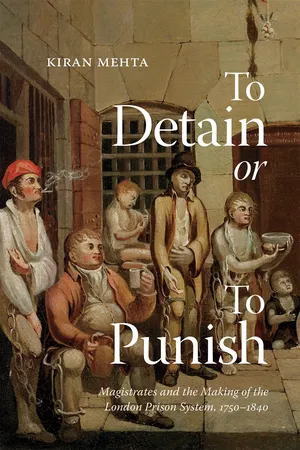
To Detain or to Punish revisits this revolutionary moment as it played out in the metropolis of London. Kiran Mehta charts how Londoners, through their interactions with police, magistrates, and judges, became prisoners, and then follows them into the prison, revealing how these institutions were managed and experienced. Local authorities’ increased use of imprisonment, for punishment as well as for detention, sparked the wholesale reconstruction and redesign of London’s prison estate. It also spurred the consolidation of the modern notion that prisoners who had not yet been convicted of a crime, or who had not been sentenced to imprisonment, should be held separately from and treated differently to those incarcerated for punishment. Most notably, the requirement to labour became a distinguishing feature of punitive confinement.
Challenging traditional ideas about who and what prisons were for and how they operated, To Detain or to Punish offers a radical reappraisal of London’s prison system between 1750 and 1840.
eBook - ePub
To Detain or to Punish
Magistrates and the Making of the London Prison System, 1750–1840
- 296 pages
- English
- ePUB (mobile friendly)
- Available on iOS & Android
eBook - ePub
About this book
Information
Table of contents
- Cover Page
- Title Page
- Copyright
- Contents
- Tables and Figures
- Acknowledgments
- Abbreviations
- Introduction: Imprisonment in the “Nation of Liberty”
- Chapter One: Becoming Prisoners: Locking People Up in Eighteenth- and Early-Nineteenth-Century London
- Chapter Two: Specialization, Labour, and Punishment
- Chapter Three: Ideologies of Reform and Realities of Pre-Reform Prisons
- Chapter Four: The Practice of Reform
- Chapter Five: The Rise of Imprisonment, 1815–50
- Chapter Six: An Age of Prison Improvements: Reform and Discipline
- Conclusion: Specialization or Uniformity
- Notes
- Bibliography of Manuscript and Archival Sources
- Index
Trusted by 375,005 students
Access to over 1.5 million titles for a fair monthly price.
Study more efficiently using our study tools.
Frequently asked questions
Yes, you can cancel anytime from the Subscription tab in your account settings on the Perlego website. Your subscription will stay active until the end of your current billing period. Learn how to cancel your subscription
No, books cannot be downloaded as external files, such as PDFs, for use outside of Perlego. However, you can download books within the Perlego app for offline reading on mobile or tablet. Learn how to download books offline
Perlego offers two plans: Essential and Complete
- Essential is ideal for learners and professionals who enjoy exploring a wide range of subjects. Access the Essential Library with 800,000+ trusted titles and best-sellers across business, personal growth, and the humanities. Includes unlimited reading time and Standard Read Aloud voice.
- Complete: Perfect for advanced learners and researchers needing full, unrestricted access. Unlock 1.5M+ books across hundreds of subjects, including academic and specialized titles. The Complete Plan also includes advanced features like Premium Read Aloud and Research Assistant.
We are an online textbook subscription service, where you can get access to an entire online library for less than the price of a single book per month. With over 1.5 million books across 990+ topics, we’ve got you covered! Learn about our mission
Look out for the read-aloud symbol on your next book to see if you can listen to it. The read-aloud tool reads text aloud for you, highlighting the text as it is being read. You can pause it, speed it up and slow it down. Learn more about Read Aloud
Yes! You can use the Perlego app on both iOS and Android devices to read anytime, anywhere — even offline. Perfect for commutes or when you’re on the go.
Please note we cannot support devices running on iOS 13 and Android 7 or earlier. Learn more about using the app
Please note we cannot support devices running on iOS 13 and Android 7 or earlier. Learn more about using the app
Yes, you can access To Detain or to Punish by Kiran Mehta in PDF and/or ePUB format, as well as other popular books in History & Early Modern History. We have over 1.5 million books available in our catalogue for you to explore.