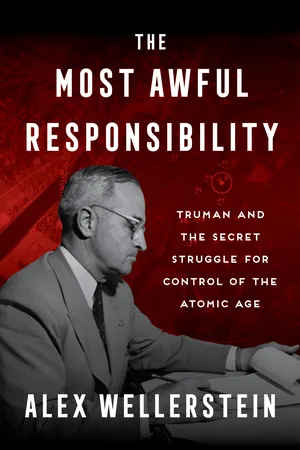
The Most Awful Responsibility
Truman and the Secret Struggle for Control of the Atomic Age
- 320 pages
- English
- ePUB (mobile friendly)
- Available on iOS & Android
The Most Awful Responsibility
Truman and the Secret Struggle for Control of the Atomic Age
About this book
"I thought I knew the story but learned much that I didn’t know. Outstanding!"— Richard Rhodes
“This is historical research at its best.” — Dan Carlin
President Truman’s choice to drop the atomic bomb is the most debated decision in the 20th Century. But what if Truman’s actual decision wasn’t what everyone thinks it was?
The conventional narrative is that American leaders had a choice: Invade Japan, which would have cost millions of Allied and Japanese lives, or instead, use the atom bomb in the hope of convincing Japan to surrender. Truman, the story goes, carefully weighed the pros and cons before deciding that the atomic bomb would be used against Japanese cities, as the lesser of two evils.
But nuclear historian Alex Wellerstein argues that is not what happened.
Not only did Truman not take part in the decision to use the bomb, but the one major decision that he did make was a very different one — one that he himself did not fully understand until after the atomic bomb was used. The weight of that decision, and that misunderstanding, became the major reason that atomic bombs have not been used again since World War II.
Based on a close reading of the historical record, The Most Awful Responsibility shows that, despite his reputation as an ardent defender of the atomic bomb, Truman:
- Wanted to avoid the “murder” and “slaughter” of innocent civilians
- Believed that the atomic bomb should never be used again
- Hoped that nuclear weapons would be outlawed in his lifetime
Wellerstein makes a startling case that Truman was possibly the most anti-nuclear American president of the twentieth century, but his ambitions were strongly constrained by the domestic and international politics of the postwar world and the early Cold War. This book is a must-read for all who want to truly understand not only why the bomb was dropped on Japan but also why it has not been used since.
Frequently asked questions
- Essential is ideal for learners and professionals who enjoy exploring a wide range of subjects. Access the Essential Library with 800,000+ trusted titles and best-sellers across business, personal growth, and the humanities. Includes unlimited reading time and Standard Read Aloud voice.
- Complete: Perfect for advanced learners and researchers needing full, unrestricted access. Unlock 1.4M+ books across hundreds of subjects, including academic and specialized titles. The Complete Plan also includes advanced features like Premium Read Aloud and Research Assistant.
Please note we cannot support devices running on iOS 13 and Android 7 or earlier. Learn more about using the app.
Information
Table of contents
- Cover
- Title Page
- Note to Readers
- Dedication
- Epigraph
- Contents
- Introduction
- 1. āIt Was Very Clear That He Knew Little of the Task into Which He Was Steppingā
- 2. āModern Civilization Might Be Completely Destroyedā
- 3. āA Blanket of Fireā
- 4. āA Decision Not to Upset the Existing Plansā
- 5. āA Profound Psychological Impressionā
- 6. āIt Makes Presiding Over the Senate Seem Tameā
- 7. āThe Target Will Be a Purely Military Oneā
- 8. āThe Greatest Thing in Historyā
- 9. āThe Thought of Wiping Out Another 100,000 People Was Too Horribleā
- 10. āIt Is a Dangerous Thing to Just Give Them the Power and Hope That They Will Not Take Advantage of Itā
- 11. āI Told Him the Blood Was on My Handsā
- 12. āThe Battle of the Atom Still Goes Onā
- 13. āIt Is Quite Possible to Depopulate Vast Areas of the Earthās Surfaceā
- 14. āIf We Arenāt Going to Use Them, That Doesnāt Make Any Senseā
- 15. āAn Atomic Explosion Occurred in the Central USSRā
- 16. āA Weapon That Will Kill Ten Million Peopleā
- 17. āWe Are in a Hell of a Messā
- 18. āA Play Actor and a Bunko Manā
- 19. āI Assume He Told Someoneā
- 20. āThat Includes Every Weapon That We Haveā
- 21. āThe Enemy Could Not Have Marched Across That Radiated Beltā
- 22. āCharting a Course from Which We Cannot Turnā
- 23. āWe Devoutly Hoped That They Would Not Have to Be Usedā
- Conclusion
- Acknowledgments
- Bibliography
- Notes
- Index
- About the Author
- Also by Alex Wellerstein
- Copyright
- About the Publisher