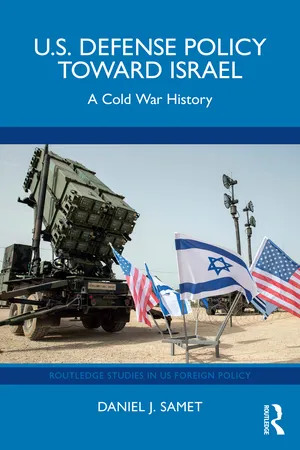
This book examines U.S. defense policy toward Israel during the Cold War, emphasizing arms sales, intelligence sharing, and other security cooperation. It argues that strategic interests drove American policy with other considerations, such as domestic politics and shared liberal values, mattering far less. It begins with the presidency of John F. Kennedy and ends with the presidency of George H. W. Bush with a particular focus on government officials: presidents, secretaries of state, secretaries of defense, national security advisors, other administration officials, and senators and Congressmen. The book explores the primacy of security as American officials feared nuclear proliferation, regional war, and a cut-off of oil supplies. All the while, tensions and often bitter disagreements in the U.S.-Israel relationship abounded over what to do about threats in the Middle East. This volume will be of interest to those studying American relations with the rest of the Middle East and U.S. security partnerships around the world.
- 296 pages
- English
- ePUB (mobile friendly)
- Available on iOS & Android
eBook - ePub
About this book
Information
Table of contents
- Cover Page
- Half Title page
- Series Page
- Title Page
- Copyright Page
- Contents
- Acknowledgments
- Acronyms
- Introduction
- 1 Camelot Shields Zion: The Kennedy Years
- 2 Aid, Aid, and More Aid: The Johnson Years
- 3 Taking It to the Soviets: The Nixon Years Part I
- 4 The Abyss Stares Back: The Nixon Years Part II and the Ford Years
- 5 A Spoonful of Idealism Helps the Pragmatism Go Down: The Carter Years
- 6 Who by Fire, Who by Water: The Reagan Years
- 7 Partnership Consummated: The Bush Years
- Conclusion
- Bibliography
- Index
Trusted by 375,005 students
Access to over 1.5 million titles for a fair monthly price.
Study more efficiently using our study tools.
Frequently asked questions
Yes, you can cancel anytime from the Subscription tab in your account settings on the Perlego website. Your subscription will stay active until the end of your current billing period. Learn how to cancel your subscription
No, books cannot be downloaded as external files, such as PDFs, for use outside of Perlego. However, you can download books within the Perlego app for offline reading on mobile or tablet. Learn how to download books offline
Perlego offers two plans: Essential and Complete
- Essential is ideal for learners and professionals who enjoy exploring a wide range of subjects. Access the Essential Library with 800,000+ trusted titles and best-sellers across business, personal growth, and the humanities. Includes unlimited reading time and Standard Read Aloud voice.
- Complete: Perfect for advanced learners and researchers needing full, unrestricted access. Unlock 1.5M+ books across hundreds of subjects, including academic and specialized titles. The Complete Plan also includes advanced features like Premium Read Aloud and Research Assistant.
We are an online textbook subscription service, where you can get access to an entire online library for less than the price of a single book per month. With over 1.5 million books across 990+ topics, we’ve got you covered! Learn about our mission
Look out for the read-aloud symbol on your next book to see if you can listen to it. The read-aloud tool reads text aloud for you, highlighting the text as it is being read. You can pause it, speed it up and slow it down. Learn more about Read Aloud
Yes! You can use the Perlego app on both iOS and Android devices to read anytime, anywhere — even offline. Perfect for commutes or when you’re on the go.
Please note we cannot support devices running on iOS 13 and Android 7 or earlier. Learn more about using the app
Please note we cannot support devices running on iOS 13 and Android 7 or earlier. Learn more about using the app
Yes, you can access U.S. Defense Policy toward Israel by Daniel Jeremy Samet,Daniel J. Samet in PDF and/or ePUB format, as well as other popular books in Politics & International Relations & Arms Control. We have over 1.5 million books available in our catalogue for you to explore.