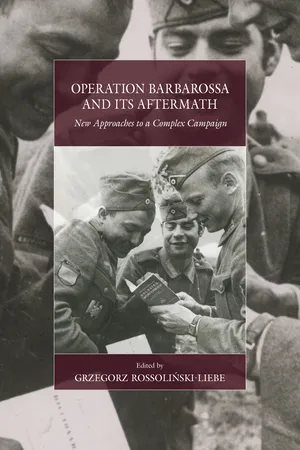
The 1941 invasion of the Soviet Union, codenamed Operation Barbarossa, remains one of Nazi Germany's most significant military campaigns. Executed by Hitler's Wehrmacht army, this event saw troops from all over Europe defeat the Red Army and temporarily colonize large swathes of Eastern Europe, ultimately laying the groundwork for the Holocaust. In this illuminating re-examination of this multifaceted event, Operation Barbarossa and its Aftermath refocuses our attention on the multiethnic nature of the campaign, shedding light on the role of soldiers from Slovakia, Italy, Romania, and Spain as well as other important issues. This volume highlights how viewing Operation Barbarossa as a multiethnic campaign, rather than a strictly German-Russian conflict, offers new ways of understanding the Holocaust, World War II and the history of European collaboration.
eBook - ePub
Operation Barbarossa and its Aftermath
New Approaches to a Complex Campaign
- 368 pages
- English
- ePUB (mobile friendly)
- Available on iOS & Android
eBook - ePub
Operation Barbarossa and its Aftermath
New Approaches to a Complex Campaign
About this book
Information
Edition
1Subtopic
Eastern European HistoryTable of contents
- Cover
- Title Page
- Copyright Page
- Contents
- List of Illustrations
- Introduction: Operation Barbarossa as a Complex Campaign
- Part I. Military
- Part II. Partisans
- Part III. Solidarity
- Part IV. Science, Ideology, and Propaganda
- Part V. Memory
- Index
Trusted by 375,005 students
Access to over 1.5 million titles for a fair monthly price.
Study more efficiently using our study tools.
Frequently asked questions
Yes, you can cancel anytime from the Subscription tab in your account settings on the Perlego website. Your subscription will stay active until the end of your current billing period. Learn how to cancel your subscription
No, books cannot be downloaded as external files, such as PDFs, for use outside of Perlego. However, you can download books within the Perlego app for offline reading on mobile or tablet. Learn how to download books offline
We are an online textbook subscription service, where you can get access to an entire online library for less than the price of a single book per month. With over 1.5 million books across 990+ topics, we’ve got you covered! Learn about our mission
Look out for the read-aloud symbol on your next book to see if you can listen to it. The read-aloud tool reads text aloud for you, highlighting the text as it is being read. You can pause it, speed it up and slow it down. Learn more about Read Aloud
Yes! You can use the Perlego app on both iOS and Android devices to read anytime, anywhere — even offline. Perfect for commutes or when you’re on the go.
Please note we cannot support devices running on iOS 13 and Android 7 or earlier. Learn more about using the app
Please note we cannot support devices running on iOS 13 and Android 7 or earlier. Learn more about using the app
Yes, you can access Operation Barbarossa and its Aftermath by Dr. Grzegorz Rossoliński-Liebe,Dr. Grzegorz Rossoliński-Liebe in PDF and/or ePUB format. We have over 1.5 million books available in our catalogue for you to explore.