How human institutions—markets, states, communities, religions, guilds and families—have helped both to control and to exacerbate epidemics throughout history
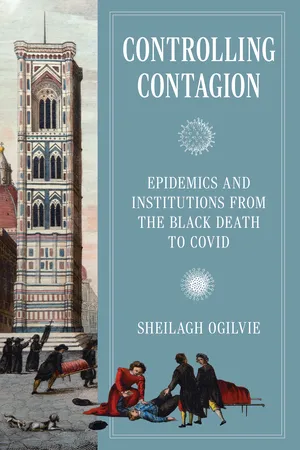
How do societies tackle epidemic disease? In Controlling Contagion, Sheilagh Ogilvie answers this question by exploring seven centuries of pandemics, from the Black Death to Covid-19. For most of history, infectious diseases have killed many more people than famine or war, and in 2019 they still caused one death in four. Today, we deal with epidemics more successfully than our ancestors managed plague, smallpox, cholera or influenza. But we use many of the same approaches. Long before scientific medicine, human societies coordinated and innovated in response to biological shocks—sometimes well, sometimes badly.
Ogilvie uses historical epidemics to analyse how human societies deal with “externalities”—situations where my action creates costs or benefits for others beyond those that I myself incur. Social institutions—markets, states, communities, religions, guilds, and families—help us manage the negative externalities of contagion and the positive externalities of social distancing, sanitation, and immunization. Ogilvie shows how each institution enables us to coordinate, innovate and inspire each other to limit contagion. But each institution also has weaknesses that can make things worse. Markets shut down voluntarily during every epidemic in history—but they also brought people together, spreading contagion. States mandated quarantines, sanitation, and immunization—but they also waged war and censored information, exacerbating epidemics. Religions admonished us to avoid infecting our neighbours—but they also preached against science and medical innovations. What decided the outcome, Ogilvie argues, was a temperate state, an adaptable market, and a strong civil society where a diversity of institutions played to their own strengths and checked each other’s flaws.
eBook - ePub
Controlling Contagion
Epidemics and Institutions from the Black Death to Covid
- 544 pages
- English
- ePUB (mobile friendly)
- Available on iOS & Android
eBook - ePub
About this book
Information
Publisher
Princeton University PressYear
2025Print ISBN
9780691266435
9780691255569
eBook ISBN
9780691267418
Table of contents
- Cover Page
- Series Page
- Title Page
- Copyright Page
- Dedication
- Contents
- List of Illustrations
- Acknowledgements
- 1. Epidemics and Institutions
- 2. The Market
- 3. The State
- 4. The Local Community
- 5. Religion
- 6. Medical Guilds and Associations
- 7. The Family
- 8. Is There a Magic Pill?
- Bibliography
- Index
- Series List
Trusted by 375,005 students
Access to over 1.5 million titles for a fair monthly price.
Study more efficiently using our study tools.
Frequently asked questions
Yes, you can cancel anytime from the Subscription tab in your account settings on the Perlego website. Your subscription will stay active until the end of your current billing period. Learn how to cancel your subscription
No, books cannot be downloaded as external files, such as PDFs, for use outside of Perlego. However, you can download books within the Perlego app for offline reading on mobile or tablet. Learn how to download books offline
Perlego offers two plans: Essential and Complete
- Essential is ideal for learners and professionals who enjoy exploring a wide range of subjects. Access the Essential Library with 800,000+ trusted titles and best-sellers across business, personal growth, and the humanities. Includes unlimited reading time and Standard Read Aloud voice.
- Complete: Perfect for advanced learners and researchers needing full, unrestricted access. Unlock 1.5M+ books across hundreds of subjects, including academic and specialized titles. The Complete Plan also includes advanced features like Premium Read Aloud and Research Assistant.
We are an online textbook subscription service, where you can get access to an entire online library for less than the price of a single book per month. With over 1.5 million books across 990+ topics, we’ve got you covered! Learn about our mission
Look out for the read-aloud symbol on your next book to see if you can listen to it. The read-aloud tool reads text aloud for you, highlighting the text as it is being read. You can pause it, speed it up and slow it down. Learn more about Read Aloud
Yes! You can use the Perlego app on both iOS and Android devices to read anytime, anywhere — even offline. Perfect for commutes or when you’re on the go.
Please note we cannot support devices running on iOS 13 and Android 7 or earlier. Learn more about using the app
Please note we cannot support devices running on iOS 13 and Android 7 or earlier. Learn more about using the app
Yes, you can access Controlling Contagion by Sheilagh Ogilvie in PDF and/or ePUB format, as well as other popular books in History & Development Economics. We have over 1.5 million books available in our catalogue for you to explore.