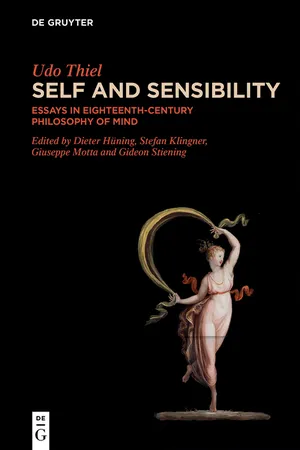
This volume collects 19 of the author's essays on eighteenth-century accounts of self-consciousness, personal identity and related issues, covering over a hundred years of a philosophical debate that has shaped the way in which these topics are discussed today. After a detailed analysis of the seventeenth-century background, the essays analyze and critically evaluate French, British and German contributions, ranging from Claude Buffier early in the century to Kant and aspects of the Post-Kantian debate. The essays deal with a large number of diverse sources, including the views and arguments of well-known philosophers such as Hume and Kant, as well as lesser-known thinkers, such as LeLarge de Lignac and Thomas Cooper, organized around four, partly overlapping main themes: a) the self and its identity as a matter of a special 'feeling' (sentiment intime, Selbstgefühl) in thinkers such as Condillac, Rousseau and Feder, b) materialist treatments of these issues in, for example, Priestley and Hißmann, c) Scottish Common Sense accounts, with a special focus on Reid, and d) Kant's analysis and the philosophical context in which it was developed, with a particular emphasis on the German debate (Wolff and his critics, Lossius, Tetens and others).
eBook - PDF
Self and Sensibility
Essays in Eighteenth-Century Philosophy of Mind
- 480 pages
- English
- PDF
- Available on iOS & Android
eBook - PDF
Self and Sensibility
Essays in Eighteenth-Century Philosophy of Mind
About this book
Information
Topic
PhilosophySubtopic
Epistemology in PhilosophyTable of contents
- Preface
- Contents
- Introduction: Self and Sensibility
- I The Seventeenth-Century Background: From Locke to Hume
- 1 Personal Identity
- 2 Hume on the Self and His ‘Overall Philosophical Scheme’
- II The Feeling of Self: From Claude Buffier to Rousseau
- 3 From Intimate Sentiment to Pure Self- Consciousness: Buffier and Lelarge de Lignac
- 4 Self and Sensibility: From Locke to Condillac and Rousseau
- 5 Between Leibniz and Locke: Charles Bonnet on Self-Consciousness and Personal Identity
- III Self-Consciousness and Personal Identity in Eighteenth-Century Materialism
- 6 Locke in Göttingen
- 7 Varieties of Inner Sense. Two Pre-Kantian Theories
- 8 Locke and Eighteenth-Century Materialist Conceptions of Personal Identity
- 9 Religion and materialist metaphysics: Some aspects of the debate about the resurrection of the body in eighteenth-century Britain
- IV Consciousness and Common Sense
- 10 Consciousness and Common Sense: From Claude Buffier to Thomas Brown
- 11 Reid and Higher Order Theories of Consciousness
- V Kant in Context 1: Consciousness and Self-Consciousness
- 12 Between Wolff and Kant: Mérian’s Theory of Apperception
- 13 Experience and Inner Sense: Feder–Lossius–Kant
- 14 Kant and Tetens on the Unity of the Self
- 15 Consciousness, Inner Sense and Self- Consciousness in the 1760s
- VI Kant in Context 2: Personhood and the Feeling of Self
- 16 The Concept of a Person in Eighteenth-Century German Philosophy: Leibniz – Wolff – Kant
- 17 The Critique of Rational Psychology
- 18 Priestley and Kant on Materialism
- 19 Between Empirical Psychology and Transcendental Philosophy: Ernst Platner on the Feeling of Self
- Bibliography
- Acknowledgments
- Index of Names
Trusted by 375,005 students
Access to over 1.5 million titles for a fair monthly price.
Study more efficiently using our study tools.
Frequently asked questions
Yes, you can cancel anytime from the Subscription tab in your account settings on the Perlego website. Your subscription will stay active until the end of your current billing period. Learn how to cancel your subscription
No, books cannot be downloaded as external files, such as PDFs, for use outside of Perlego. However, you can download books within the Perlego app for offline reading on mobile or tablet. Learn how to download books offline
Perlego offers two plans: Essential and Complete
- Essential is ideal for learners and professionals who enjoy exploring a wide range of subjects. Access the Essential Library with 800,000+ trusted titles and best-sellers across business, personal growth, and the humanities. Includes unlimited reading time and Standard Read Aloud voice.
- Complete: Perfect for advanced learners and researchers needing full, unrestricted access. Unlock 1.5M+ books across hundreds of subjects, including academic and specialized titles. The Complete Plan also includes advanced features like Premium Read Aloud and Research Assistant.
We are an online textbook subscription service, where you can get access to an entire online library for less than the price of a single book per month. With over 1.5 million books across 990+ topics, we’ve got you covered! Learn about our mission
Look out for the read-aloud symbol on your next book to see if you can listen to it. The read-aloud tool reads text aloud for you, highlighting the text as it is being read. You can pause it, speed it up and slow it down. Learn more about Read Aloud
Yes! You can use the Perlego app on both iOS and Android devices to read anytime, anywhere — even offline. Perfect for commutes or when you’re on the go.
Please note we cannot support devices running on iOS 13 and Android 7 or earlier. Learn more about using the app
Please note we cannot support devices running on iOS 13 and Android 7 or earlier. Learn more about using the app
Yes, you can access Self and Sensibility by Udo Thiel, Dieter Hüning,Stefan Klingner,Giuseppe Motta,Gideon Stiening in PDF and/or ePUB format, as well as other popular books in Philosophy & Epistemology in Philosophy. We have over 1.5 million books available in our catalogue for you to explore.