In 1770 a handful of European nations ruled the Americas, drawing from them a stream of products, both everyday and exotic. Some two and a half million black slaves, imprisoned in plantation colonies, toiled to produce the sugar, coffee, cotton, ginger and indigo craved by Europeans. By 1848 the major systems of colonial slavery had been swept away either by independence movements, slave revolts, abolitionists or some combination of all three. How did this happen?
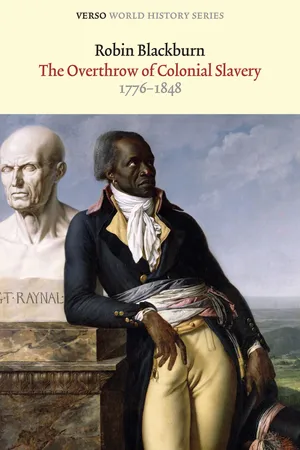
Robin Blackburn's history captures the complexity of a revolutionary age in a compelling narrative. In some cases colonial rule fell while slavery flourished, as happened in the South of the United States and in Brazil; elsewhere slavery ended but colonial rule remained, as in the British West Indies and French Windwards. But in French St. Domingue, the future Haiti, and in Spanish South and Central America both colonialism and slavery were defeated. This story of slave liberation and American independence highlights the pivotal role of the "first emancipation" in the French Antilles in the 1790s, the parallel actions of slave resistance and metropolitan abolitionism, and the contradictory implications of slaveholder patriotism.
The dramatic events of this epoch are examined from an unexpected vantage point, showing how the torch of anti-slavery passed from the medieval communes to dissident Quakers, from African maroons to radical pirates, from Granville Sharp and Ottabah Cuguano to Toussaint L'Ouverture, from the black Jacobins to the Liberators of South America, and from the African Baptists in Jamaica to the Revolutionaries of 1848 in Europe and the Caribbean.
- 570 pages
- English
- ePUB (mobile friendly)
- Available on iOS & Android
eBook - ePub
About this book
Information
Subtopic
World HistoryIndex
HistoryTable of contents
- Cover
- Title Page
- Copyright Page
- Dedication
- Contents
- List of Maps
- Acknowledgements
- Introduction: Colonial Slavery in the New World c. 1770
- I. The Origins of Anti-Slavery
- II. Hanoverian Britain: Slavery and Empire
- III. Slavery and the American Revolution
- IV. British Abolitionism and the Backlash of the 1790s
- V. The French Revolution and the Antilles: 1789–93
- VI. Revolutionary Emancipationism and the Birth of Haiti
- VII. Abolition and Empire: The United States
- VIII. British Slave Trade Abolition: 1803–14
- IX. Spanish America: Independence and Emancipation
- X. Cuba and Brazil: the Abolitionist Impasse
- XI. The Struggle for British Slave Emancipation: 1823–38
- XII. French Restoration Slavery and 1848
- XIII. Conclusion: Results and Prospects
- Index
Trusted by 375,005 students
Access to over 1.5 million titles for a fair monthly price.
Study more efficiently using our study tools.
Frequently asked questions
Yes, you can cancel anytime from the Subscription tab in your account settings on the Perlego website. Your subscription will stay active until the end of your current billing period. Learn how to cancel your subscription
No, books cannot be downloaded as external files, such as PDFs, for use outside of Perlego. However, you can download books within the Perlego app for offline reading on mobile or tablet. Learn how to download books offline
Perlego offers two plans: Essential and Complete
- Essential is ideal for learners and professionals who enjoy exploring a wide range of subjects. Access the Essential Library with 800,000+ trusted titles and best-sellers across business, personal growth, and the humanities. Includes unlimited reading time and Standard Read Aloud voice.
- Complete: Perfect for advanced learners and researchers needing full, unrestricted access. Unlock 1.5M+ books across hundreds of subjects, including academic and specialized titles. The Complete Plan also includes advanced features like Premium Read Aloud and Research Assistant.
We are an online textbook subscription service, where you can get access to an entire online library for less than the price of a single book per month. With over 1.5 million books across 990+ topics, we’ve got you covered! Learn about our mission
Look out for the read-aloud symbol on your next book to see if you can listen to it. The read-aloud tool reads text aloud for you, highlighting the text as it is being read. You can pause it, speed it up and slow it down. Learn more about Read Aloud
Yes! You can use the Perlego app on both iOS and Android devices to read anytime, anywhere — even offline. Perfect for commutes or when you’re on the go.
Please note we cannot support devices running on iOS 13 and Android 7 or earlier. Learn more about using the app
Please note we cannot support devices running on iOS 13 and Android 7 or earlier. Learn more about using the app
Yes, you can access The Overthrow of Colonial Slavery by Robin Blackburn in PDF and/or ePUB format, as well as other popular books in History & World History. We have over 1.5 million books available in our catalogue for you to explore.