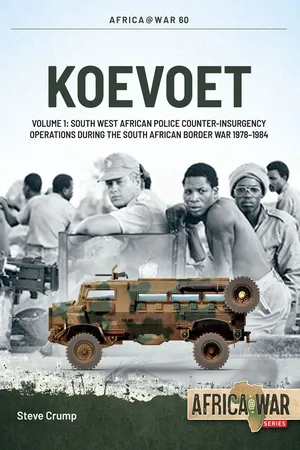
Koevoet (Afrikaans for 'Crowbar') tells of the origination and deployment of the South West African Police's elite counter-insurgency capability during the South African Border War of 1978–1989. Drawing upon previously unpublished sources and from interviews with a number of key personalities, including former members of Koevoet, this volume, the first of two, documents the formation of Koevoet and its early operations up to 1984. Koevoet examines the background and context to the South West African conflict and details the early experiences of the South African Police in seeking to counter SWAPO/PLAN activities. It outlines the tasking assigned to Colonel Hans Dreyer of the South African Police to establish 'Ops K' and to develop a counter-insurgency unit as part of the South West African Police response to the developing conflict; a unit that was to become both respected and feared and is, today, considered as one of the most effective counter-insurgency forces of modern times. Koeveot describes the recruitment of trackers from the local population; the integration of black and white Koevoet operators into a single entity; their training, organization and deployment across the 'Operational Area'. The author examines Koevoet tactics in the field – including all arms co-operation with the South African Defence Force and the South African Air Force and the practice of 'turning' captured SWAPO/PLAN fighters and their employment across the Zulu teams. The design and evolution of the iconic Casspir and Wolf Mine-Protected Vehicles (MPVs) is covered as is their practical use on operations, alongside the development of other specialized weapons and equipment utilized by Koevoet. In documenting Koevoet operations in Kavnago, Kaokoland and Owamboland, Volume 1 of Koevoet seeks to examine SWAPOL-COIN's effectiveness and to assess how the lessons learned between 1979–1984, shaped future Koevoet doctrine and thinking, to afford the reader a truly inclusive perspective on counter-insurgency today as police and armed forces globally move to a greater reliance on cutting-edge digital technology, including artificial intelligence. Color profiles detail a range Mine-Protected Vehicles (MPVs) used by Koevoet, including the iconic Casspir and Wolf, along with SADF and SAAF helicopters used to support these operations. Uniforms and insignia of Koevoet are presented in specially commissioned full color artworks.
eBook - PDF
Koevoet
Volume 1 - South West African Police Counter-Insurgency Operations during the South African Border War, 1978-1984
- 68 pages
- English
- PDF
- Available on iOS & Android
eBook - PDF
Koevoet
Volume 1 - South West African Police Counter-Insurgency Operations during the South African Border War, 1978-1984
About this book
Information
Table of contents
- Front Cover
- Copyright
- Contents
- Glossary
- Acknowledgements
- Preface
- Introduction
- 1 The Road to War: The Ongulumbashe Raid and Formation of the OZ Guards
- 2 Transition from Home Guard to Ops K
- 3 Koevoet – The Early Days
- 4 Koevoet’s Initial Doctrine and Tactics
- 5 1981 – Koevoet Expands
- 6 1982 – Operation Yahoo: Collaboration with the SADF
- 7 1983 – Koevoet Consolidates
- 8 1984 – The Lusaka Accord: Koevoet Stands Firm
- Bibliography
- Notes
- About the Author
- Plates
- Back Cover
Trusted by 375,005 students
Access to over 1.5 million titles for a fair monthly price.
Study more efficiently using our study tools.
Frequently asked questions
Yes, you can cancel anytime from the Subscription tab in your account settings on the Perlego website. Your subscription will stay active until the end of your current billing period. Learn how to cancel your subscription
No, books cannot be downloaded as external files, such as PDFs, for use outside of Perlego. However, you can download books within the Perlego app for offline reading on mobile or tablet. Learn how to download books offline
Perlego offers two plans: Essential and Complete
- Essential is ideal for learners and professionals who enjoy exploring a wide range of subjects. Access the Essential Library with 800,000+ trusted titles and best-sellers across business, personal growth, and the humanities. Includes unlimited reading time and Standard Read Aloud voice.
- Complete: Perfect for advanced learners and researchers needing full, unrestricted access. Unlock 1.5M+ books across hundreds of subjects, including academic and specialized titles. The Complete Plan also includes advanced features like Premium Read Aloud and Research Assistant.
We are an online textbook subscription service, where you can get access to an entire online library for less than the price of a single book per month. With over 1.5 million books across 990+ topics, we’ve got you covered! Learn about our mission
Look out for the read-aloud symbol on your next book to see if you can listen to it. The read-aloud tool reads text aloud for you, highlighting the text as it is being read. You can pause it, speed it up and slow it down. Learn more about Read Aloud
Yes! You can use the Perlego app on both iOS and Android devices to read anytime, anywhere — even offline. Perfect for commutes or when you’re on the go.
Please note we cannot support devices running on iOS 13 and Android 7 or earlier. Learn more about using the app
Please note we cannot support devices running on iOS 13 and Android 7 or earlier. Learn more about using the app
Yes, you can access Koevoet by Steve Crump in PDF and/or ePUB format, as well as other popular books in History & 20th Century History. We have over 1.5 million books available in our catalogue for you to explore.