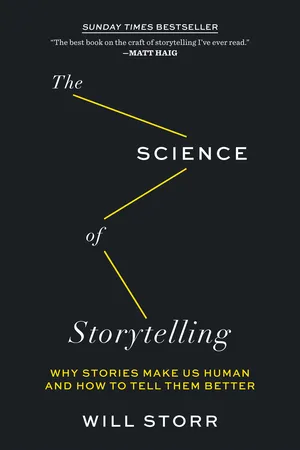
The compelling, groundbreaking guide to creative writing that reveals how the brain responds to storytellingStories shape who we are. They drive us to act out our dreams and ambitions and mold our beliefs. Storytelling is an essential part of what makes us human. So, how do master storytellers compel us? In The Science of Storytelling, award-winning writer and acclaimed teacher of creative writing Will Storr applies dazzling psychological research and cutting-edge neuroscience to our myths and archetypes to show how we can write better stories, revealing, among other things, how storytellers-and also our brains-create worlds by being attuned to moments of unexpected change.Will Storr's superbly chosen examples range from Harry Potter to Jane Austen to Alice Walker, Greek drama to Russian novels to Native American folk tales, King Lear to Breaking Bad to children's stories. With sections such as "e;The Dramatic Question, "e; "e;Creating a World, "e; and "e;Plot, Endings, and Meaning, "e; as well as a practical, step-by-step appendix dedicated to "e;The Sacred Flaw Approach, "e; The Science of Storytelling reveals just what makes stories work, placing it alongside such creative writing classics as John Yorke's Into the Woods: A Five-Act Journey into Story and Lajos Egri's The Art of Dramatic Writing. Enlightening and empowering, The Science of Storytelling is destined to become an invaluable resource for writers of all stripes, whether novelist, screenwriter, playwright, or writer of creative or traditional nonfiction.
- 304 pages
- English
- ePUB (mobile friendly)
- Available on iOS & Android
eBook - ePub
About this book
Information
Edition
0Table of contents
- Cover
- Title Page
- Copyright Page
- Dedication
- Contents
- Introduction
- Chapter One: Creating a World
- Chapter Two: The Flawed Self
- Chapter Three: The Dramatic Question
- Chapter Four: Plots, Endings and Meaning
- Appendix: The Sacred Flaw Approach
Trusted by 375,005 students
Access to over 1.5 million titles for a fair monthly price.
Study more efficiently using our study tools.
Frequently asked questions
Yes, you can cancel anytime from the Subscription tab in your account settings on the Perlego website. Your subscription will stay active until the end of your current billing period. Learn how to cancel your subscription
No, books cannot be downloaded as external files, such as PDFs, for use outside of Perlego. However, you can download books within the Perlego app for offline reading on mobile or tablet. Learn how to download books offline
Perlego offers two plans: Essential and Complete
- Essential is ideal for learners and professionals who enjoy exploring a wide range of subjects. Access the Essential Library with 800,000+ trusted titles and best-sellers across business, personal growth, and the humanities. Includes unlimited reading time and Standard Read Aloud voice.
- Complete: Perfect for advanced learners and researchers needing full, unrestricted access. Unlock 1.5M+ books across hundreds of subjects, including academic and specialized titles. The Complete Plan also includes advanced features like Premium Read Aloud and Research Assistant.
We are an online textbook subscription service, where you can get access to an entire online library for less than the price of a single book per month. With over 1.5 million books across 990+ topics, we’ve got you covered! Learn about our mission
Look out for the read-aloud symbol on your next book to see if you can listen to it. The read-aloud tool reads text aloud for you, highlighting the text as it is being read. You can pause it, speed it up and slow it down. Learn more about Read Aloud
Yes! You can use the Perlego app on both iOS and Android devices to read anytime, anywhere — even offline. Perfect for commutes or when you’re on the go.
Please note we cannot support devices running on iOS 13 and Android 7 or earlier. Learn more about using the app
Please note we cannot support devices running on iOS 13 and Android 7 or earlier. Learn more about using the app
Yes, you can access Science of Storytelling by in PDF and/or ePUB format. We have over 1.5 million books available in our catalogue for you to explore.