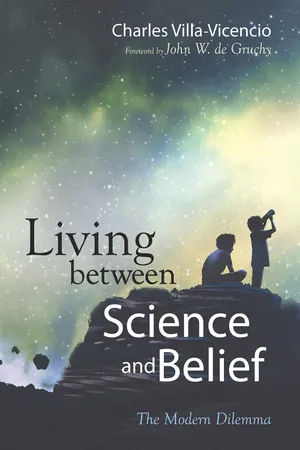
Most thoughtful people live in an interregnum between science and religion. Traditional religious answers concerning the beginning, purpose, and end of life are questioned by the natural sciences, with neuroscience conceivably constituting the last frontier where skeptics and believers explore common ground. The question concerns the nature of reflective and creative moments in life. Can these be reduced to the intersect between the nerve cells and molecules of the physical brain? Does this account for the human sense of mystery, or even spirituality? Is there a nexus between the physical and unknown dimensions of existence? The mutation in the history of theism suggest that progressive theology in the West may be set for a further change.
eBook - PDF
About this book
Table of contents
- CONTENTS
- Foreword
- Acknowledgments
- Introduction: Known, Unknown, and Unknowability
- 1. Where Believers, Atheists, and Skeptics Meet
- 2. The Being of God
- 3. Judaism: The Spirit of Prophecy
- 4. Christianity: The Humanity of God
- 5. Islam: Allah - Far and Near
- 6. Consciousness: Old and New
- Bibliography
Trusted by 375,005 students
Access to over 1.5 million titles for a fair monthly price.
Study more efficiently using our study tools.