A brilliant, fascinating portrait of the intellectual tradition of Greek writers and thinkers during the Age of Rome. In 146 BC, Greece yielded to the military might of the Roman Republic; sixty years later, when Athens and other Greek city-states rebelled against Rome, the Roman general Lucius Cornelius Sulla destroyed the city of Socrates and Plato, laying waste to the famous Academy where Aristotle had studied. However, the traditions of Greek cultural life continued to flourish during the centuries of Roman rule that followed—in the lives and work of a distinguished array of philosophers, doctors, scientists, geographers, and theologians. Charles Freeman's accounts of such luminaries as the physician Galen, the geographer Ptolemy, and the philosopher Plotinus are interwoven with contextual "interludes" that showcase a sequence of unjustly neglected and richly influential lives. A cultural history on an epic scale, The Children of Athena presents the story of a rich and vibrant tradition of Greek intellectual inquiry across a period of more than five hundred years, from the second century BC to the start of the fifth century AD.
eBook - ePub
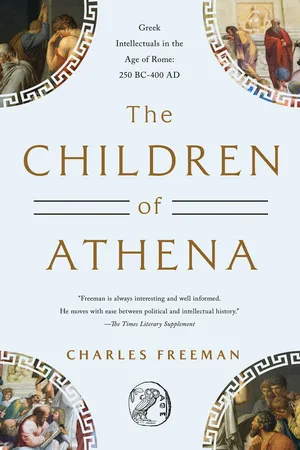
The Children of Athena
Greek Intellectuals in the Age of Rome: 150 BC-400 AD
- 320 pages
- English
- ePUB (mobile friendly)
- Available on iOS & Android
eBook - ePub
About this book
Information
Table of contents
- Cover
- Title Page
- Dedication
- Prologue: The Banquet
- Chapter 1: Introduction: Greece Becoming Roman
- Chapter 2: Scrolls, Education and Travel
- Chapter 3: Philosophy and its Schools
- Chapter 4: The Historian: Polybius
- Chapter 5: The Polymath: Posidonius
- Chapter 6: The Geographer: Strabo
- Interlude One: The Res Gestae of Augustus and the Sebasteion of Aphrodisias
- Chapter 7: The Botanist: Dioscorides
- Chapter 8: The Philosopher and Biographer: Plutarch
- Interlude Two: Hadrian and the Patronage of Greek Culture
- Chapter 9: The Stoic Philosopher: Epictetus
- Chapter 10: The Politician, Historian and Philosopher: Arrian of Nicomedia
- Chapter 11: The Geographer and Astronomer: Claudius Ptolemy
- Chapter 12: The Satirist: Lucian of Samosata
- Chapter 13: The Medical Man: Galen
- Chapter 14: The Travel Guide: Pausanias
- Interlude Three: City Life in Second-century Asia Minor: Sagalassos
- Chapter 15: The Politician and Orator: Dio Chrysostom
- Chapter 16: The Rhetorician: Aelius Aristides
- Chapter 17: The Politician and Philanthropist: Herodes Atticus
- Interlude Four: The Clouds Darken: The Greek World in an Age of Crisis
- Chapter 18: The Philosopher: Plotinus
- Chapter 19: The Platonic Theologian: Clement of Alexandria
- Chapter 20: The Biblical Scholar: Origen
- Interlude Five: Constantinople and the Promulgation of Christian Orthodoxy
- Chapter 21: The Court Orator: Themistius
- Chapter 22: The Last of the Pagan Orators: Libanius
- Chapter 23: The Neoplatonist Philosopher and Mathematician: Hypatia
- Chapter 24: Afterlives
- Photographs
- Acknowledgements
- About the Author
- Bibliography and Notes on Sources
- Index
- Picture Credits
- Copyright
Trusted by 375,005 students
Access to over 1.5 million titles for a fair monthly price.
Study more efficiently using our study tools.
Frequently asked questions
Yes, you can cancel anytime from the Subscription tab in your account settings on the Perlego website. Your subscription will stay active until the end of your current billing period. Learn how to cancel your subscription
No, books cannot be downloaded as external files, such as PDFs, for use outside of Perlego. However, you can download books within the Perlego app for offline reading on mobile or tablet. Learn how to download books offline
Perlego offers two plans: Essential and Complete
- Essential is ideal for learners and professionals who enjoy exploring a wide range of subjects. Access the Essential Library with 800,000+ trusted titles and best-sellers across business, personal growth, and the humanities. Includes unlimited reading time and Standard Read Aloud voice.
- Complete: Perfect for advanced learners and researchers needing full, unrestricted access. Unlock 1.5M+ books across hundreds of subjects, including academic and specialized titles. The Complete Plan also includes advanced features like Premium Read Aloud and Research Assistant.
We are an online textbook subscription service, where you can get access to an entire online library for less than the price of a single book per month. With over 1.5 million books across 990+ topics, we’ve got you covered! Learn about our mission
Look out for the read-aloud symbol on your next book to see if you can listen to it. The read-aloud tool reads text aloud for you, highlighting the text as it is being read. You can pause it, speed it up and slow it down. Learn more about Read Aloud
Yes! You can use the Perlego app on both iOS and Android devices to read anytime, anywhere — even offline. Perfect for commutes or when you’re on the go.
Please note we cannot support devices running on iOS 13 and Android 7 or earlier. Learn more about using the app
Please note we cannot support devices running on iOS 13 and Android 7 or earlier. Learn more about using the app
Yes, you can access The Children of Athena by Charles Freeman in PDF and/or ePUB format, as well as other popular books in History & Philosopher Biographies. We have over 1.5 million books available in our catalogue for you to explore.