An evidence-based guide for doctors diagnosing, testing, and treating children with PANDAS (Pediatric Autoimmune Neuropsychiatric Disorder Associated with Strep infections). In the early 1990s, a group of researchers at the National Institute of Mental Health began collecting data on children who had developed neuropsychiatric disorders (OCD and tics) following infections. They found evidence that antineuronal antibodies had developed in some of these children which attacked the basal ganglia region of the brain. MRI and PET scans in these children demonstrated inflammatory changes in the basal ganglia as well. In 1997, the researchers published the first article to describe this syndrome that they named PANDAS (Pediatric Autoimmune Neuropsychiatric Disorder Associated with Strep infections).In PANDAS, an autoimmune attack on the brain occurs following a Strep infection. PANS (Pediatric Acute-onset Neuropsychiatric Syndrome) is a broader term that also includes cases following exposure to other infections, toxins, and even stress. Clinicians treating children with PANS and PANDAS have found that antibiotics targeted at the offending organisms, steroids, and IVIG results in marked improvement and occasionally complete remission of the neuropsychiatric symptoms.Disturbing symptoms consistent with many DSM-5 psychiatric disorders manifest in patients with PANS and PANDAS—yet we know that there is a biologic basis for the changes in these children. As a result, these disorders require us, as physicians, to view mental illness in an entirely new way. Resistance to this change in paradigm has made PANS and PANDAS difficult for clinicians to diagnose, unbearable for parents to endure, and controversial for scholars to accept. As such, there is no recognized standard of care. We have written this work in an effort to change that. This is a textbook by physicians for physicians. It was written to bring back some of the art of medicine to physicians caring for a group of children and families who really need it. PANS and PANDAS are complex disorders that demand a rich, multifaceted response with novel treatment approaches. The material in this book is assembled from the peer-reviewed medical literature, in combination with over thirty years of clinical experience caring for the sickest patients, both in and out of the hospital. Here you will find conclusive evidence for the existence and pathophysiology of PANS and PANDAS, alongside testing and treatment interventions the author has successfully used in his own practice with hundreds of children. The book concludes with rich appendices including commonly used labs, doses of medications and supplements, a sample flare protocol, extensive support for parents, sample IVIG orders, and much more.We hope this resource allows you, the physician, to help these suffering families heal.
eBook - ePub
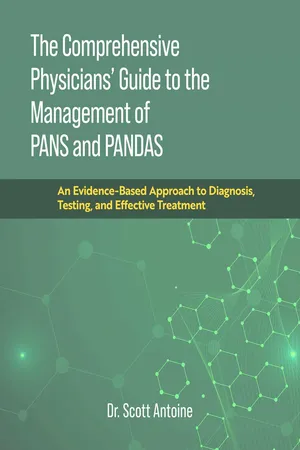
The Comprehensive Physicians' Guide to the Management of PANS and PANDAS
An Evidence-Based Approach to Diagnosis, Testing, and Effective Treatment
- 320 pages
- English
- ePUB (mobile friendly)
- Available on iOS & Android
eBook - ePub
The Comprehensive Physicians' Guide to the Management of PANS and PANDAS
An Evidence-Based Approach to Diagnosis, Testing, and Effective Treatment
About this book
Information
Topic
MedicinaSubtopic
Medicina pediatricaTable of contents
- Cover
- Title Page
- Dedication
- Foreword
- Preface: Why I Wrote This Textbook and How It Can Help Physicians
- Chapter 1: Diagnosing PANS and PANDAS
- Chapter 2: The Science and History behind PANS and PANDAS
- Chapter 3: The Problem: Overload, Overwhelm, Overflow
- Chapter 4: The Solution: The Fully Functional® Process
- Chapter 5: Identify: Environmental Toxins, Toxicants, Stress, and Symptoms
- Chapter 6: Identify: The Physical Exam in PANS and PANDAS
- Chapter 7: Identify: Laboratory and Radiology Testing in PANS and PANDAS
- Chapter 8: Identify: Infections (‘Strep, Mycoplasma’, and Other Bacterial, Parasitic, and Viral Infections)
- Chapter 9: Identify: Tick-borne Infections
- Chapter 10: Reduce: Symptoms
- Chapter 11: Reduce: Environmental Toxins and Toxicants
- Chapter 12: Reduce: Inflammation, Oxidative Stress, and Toxins in the Body
- Chapter 13: Reduce: Immune Dysregulation
- Chapter 14: Considerations for Antimicrobial Therapy, Biofilms, and Initial Antibiotic Choices
- Chapter 15: Treating ‘Strep, Mycoplasma’, and Other Bacterial, Parasitic, and Viral Infections
- Chapter 16: Treating Tick-borne Infections
- Chapter 17: Optimizing Detoxification
- Chapter 18: Support
- Chapter 19: Personalize
- Chapter 20: Therapeutic Approaches to Autonomic Nervous System Dysfunction
- Chapter 21: Additional Adjunctive Therapies: Neurolinguistic Programming and Hypnosis
- Appendix A: Laboratory and Radiology Tests
- Appendix B: Medication and Supplement Dosages
- Appendix C: Sample PANS/PANDAS Flare Protocol
- Appendix D: Parent Resources
- Appendix E: Sample IVIG Orders and Helpful Tips
- About the Author
- Copyright
Trusted by 375,005 students
Access to over 1.5 million titles for a fair monthly price.
Study more efficiently using our study tools.
Frequently asked questions
Yes, you can cancel anytime from the Subscription tab in your account settings on the Perlego website. Your subscription will stay active until the end of your current billing period. Learn how to cancel your subscription
No, books cannot be downloaded as external files, such as PDFs, for use outside of Perlego. However, you can download books within the Perlego app for offline reading on mobile or tablet. Learn how to download books offline
Perlego offers two plans: Essential and Complete
- Essential is ideal for learners and professionals who enjoy exploring a wide range of subjects. Access the Essential Library with 800,000+ trusted titles and best-sellers across business, personal growth, and the humanities. Includes unlimited reading time and Standard Read Aloud voice.
- Complete: Perfect for advanced learners and researchers needing full, unrestricted access. Unlock 1.5M+ books across hundreds of subjects, including academic and specialized titles. The Complete Plan also includes advanced features like Premium Read Aloud and Research Assistant.
We are an online textbook subscription service, where you can get access to an entire online library for less than the price of a single book per month. With over 1.5 million books across 990+ topics, we’ve got you covered! Learn about our mission
Look out for the read-aloud symbol on your next book to see if you can listen to it. The read-aloud tool reads text aloud for you, highlighting the text as it is being read. You can pause it, speed it up and slow it down. Learn more about Read Aloud
Yes! You can use the Perlego app on both iOS and Android devices to read anytime, anywhere — even offline. Perfect for commutes or when you’re on the go.
Please note we cannot support devices running on iOS 13 and Android 7 or earlier. Learn more about using the app
Please note we cannot support devices running on iOS 13 and Android 7 or earlier. Learn more about using the app
Yes, you can access The Comprehensive Physicians' Guide to the Management of PANS and PANDAS by Scott Antoine in PDF and/or ePUB format, as well as other popular books in Medicina & Medicina pediatrica. We have over 1.5 million books available in our catalogue for you to explore.