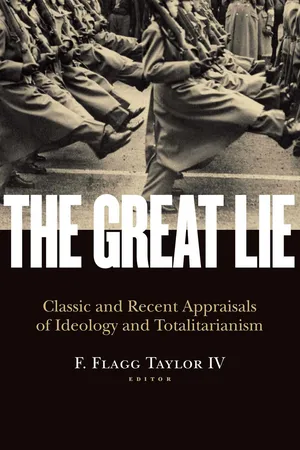
The Most Insightful and Profound Reflections on Tyranny. Totalitarianism was the dominant phenomenon of the twentieth century. Deeply troubling questions endure regarding the nature of such tyrannical regimes: What enabled human beings to carry out such horrific crimes against their fellow man? What does the endurance of Communism reveal about human liberty? Why did human beings suffer rule by ideological lies for so long, and what kept them open to the truth? What are we to make of the relationship between totalitarianism and the foundational principles of democratic modernity?Some of the greatest minds of the twentieth century sought answers to these haunting questions. Now, for the first time ever, their incisive and profound reflections on totalitarianism have been brought together in one book. The Great Lie showcases the insights of such giants as Aleksandr Solzhenitsyn, Vaclav Havel, Hannah Arendt, Eric Voegelin, Czeslaw Milosz, Leo Strauss, and Raymond Aron, along with neglected but important thinkers such as Waldemar Gurian, Aurel Kolnai, Leszek Kolakowski, Pierre Manent, Claude Lefort, and Chantal Delsol.The brilliant essays in this volume illuminate the very nature of totalitarian regimes, and the monstrous ideology that is their defining feature. The Great Lie allows readers to make sense of political evil and how it can attract so many people into its ideological fold. This is not a matter of mere academic interest in an age when we confront totalitarianism in such regimes as North Korea and Cuba—and, arguably, in radical Islamist movements.
eBook - ePub
The Great Lie
Classic and Recent Appraisals of Ideology and Totalitarianism
- 698 pages
- English
- ePUB (mobile friendly)
- Available on iOS & Android
eBook - ePub
About this book
Information
Table of contents
- Cover
- Title Page
- Note on the Text
- Epigraph
- Introduction
- Part I: Concepts
- Part II: Nature
- Part III: Origins
- Part IV: Seduction
- Part V: Dissent
- Part VI: Lessons
- Acknowledgments
- Sources and Permissions
- About the Contributors
- Notes
- Index
- Copyright
Trusted by 375,005 students
Access to over 1.5 million titles for a fair monthly price.
Study more efficiently using our study tools.
Frequently asked questions
Yes, you can cancel anytime from the Subscription tab in your account settings on the Perlego website. Your subscription will stay active until the end of your current billing period. Learn how to cancel your subscription
No, books cannot be downloaded as external files, such as PDFs, for use outside of Perlego. However, you can download books within the Perlego app for offline reading on mobile or tablet. Learn how to download books offline
Perlego offers two plans: Essential and Complete
- Essential is ideal for learners and professionals who enjoy exploring a wide range of subjects. Access the Essential Library with 800,000+ trusted titles and best-sellers across business, personal growth, and the humanities. Includes unlimited reading time and Standard Read Aloud voice.
- Complete: Perfect for advanced learners and researchers needing full, unrestricted access. Unlock 1.5M+ books across hundreds of subjects, including academic and specialized titles. The Complete Plan also includes advanced features like Premium Read Aloud and Research Assistant.
We are an online textbook subscription service, where you can get access to an entire online library for less than the price of a single book per month. With over 1.5 million books across 990+ topics, we’ve got you covered! Learn about our mission
Look out for the read-aloud symbol on your next book to see if you can listen to it. The read-aloud tool reads text aloud for you, highlighting the text as it is being read. You can pause it, speed it up and slow it down. Learn more about Read Aloud
Yes! You can use the Perlego app on both iOS and Android devices to read anytime, anywhere — even offline. Perfect for commutes or when you’re on the go.
Please note we cannot support devices running on iOS 13 and Android 7 or earlier. Learn more about using the app
Please note we cannot support devices running on iOS 13 and Android 7 or earlier. Learn more about using the app
Yes, you can access The Great Lie by F. Flagg Taylor in PDF and/or ePUB format, as well as other popular books in History & Fascism & Totalitarianism. We have over 1.5 million books available in our catalogue for you to explore.