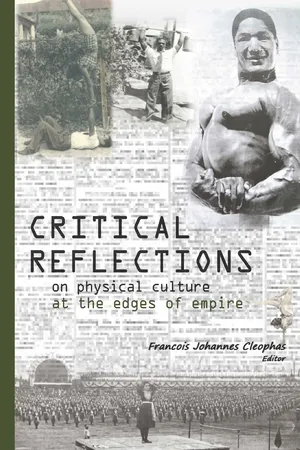
This groundbreaking anthology provides a transnational view of the use of physical culture practices - to strengthen, discipline, and reimagine the human body. Exploring theses of colonialism, gender disparities, and race relations, this international examination of bodily practices is a must read for all sport historians and those interested in physical training and its meanings. Erudite, solid, enlightening, this is a truly valuable book for our field.
- 226 pages
- English
- PDF
- Available on iOS & Android
eBook - PDF
About this book
Table of contents
- Contents
- Acknowledgements
- Introduction
- 1. Creating a decolonising South African physicalculture archive: A case study of Ron Eland
- 2. The shaping of non-racial bodybuilding in South Africa: David Isaacs and others
- 3. Přemysl’s soldiers and Libuše’s companions: On gender and the limits of female emancipation in the Sokol gymnastic movement
- 4. Steeplechase: personal reflections on Fit2Run’s race of life
- 5. Imperial benevolence and emancipatory discourses: Harry Crowe Buck and Charles Harold McCloy take the‘Y’ to India and China in the early decades of the 20th century
- 6. Re-engaging non-racial sport: The Teachers’ League of South Africa (TLSA) and the school sport movement in the Western Cape, 1956-1994
- 7. Of boots and bare feet: Footwear, race and civilisationin Australian sport before World War II
- 8. Health for the masses? Physical culture, radio and the state in 1930s Ireland
- 9. Bats, balls and boards: Islands, beaches and decolonising Pacific sport
- 10. From apartheid to democracy: the response of Cape Town‑based mountain clubs to the changing political landscape, 1970-1994
- 11. Sport and physical culture at the edges of the imperial project
- Contributors
Trusted by 375,005 students
Access to over 1.5 million titles for a fair monthly price.
Study more efficiently using our study tools.