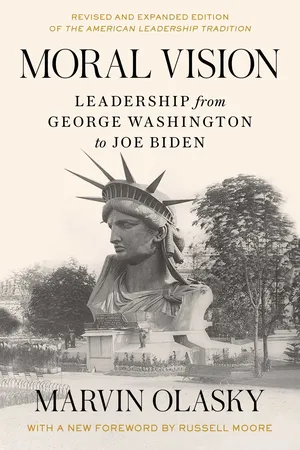
What makes a leader truly great? Is it simply a matter of management style and personality? Or is it character that matters most? Moral Visions takes an insightful look into America’s leaders of the past to answer these questions and demonstrates that values and moral convictions are critical to the strength of a nation.
Supposedly, we learn about the candidates for the highest office through a series of tests called “debates,” which are instead an exchange of soundbites. We can’t know whether an aspirant to the presidency has the ability to ask good questions or only a suave or belligerent ability to answer them. Moral Vision is a human-interest introduction to American history through studies of nineteen leaders: presidents, almost presidents, a tycoon, a crusading journalist, and even a leading 19th century abortionist. Its lessons can help voters sort through the candidates in 2024 and beyond by measuring them against previous leaders—none of whom was faultless. It shows how the deepest views often grow out of religious belief and influence political goals, racial prejudices, sexual activities, uses of power, and senses of service.
In his 1789 inaugural address, George Washington pledged that “the foundation for national policy will be laid in the sure and immutable principles of private morality.” Marvin Olasky shows how 19th-century leaders like Thomas Jefferson, Andrew Jackson, and Grover Cleveland partly upheld and partly ignored that promise, and 20th-century leaders like Woodrow Wilson, John F. Kennedy, and Bill Clinton tried to “compartmentalize” the private and the public.
An extensively updated version of The American Leadership Tradition, Moral Vision is for anyone tired of today’s textbook tendencies to submerge the role of individuals as big economic and demographic waves roll in. History is more than statistics, economics, and group identities. Human beings are more than paper boats riding the rainfall into gutters.
- 464 pages
- English
- ePUB (mobile friendly)
- Available on iOS & Android
eBook - ePub
About this book
Information
Table of contents
- Cover
- Title Page
- Dedication
- Epigraph
- Foreword
- Foreword to the 1999 Edition
- Introduction
- Part One: Early America
- Part Two: Transforming America
- Part Three: Modern America
- Part Four: Postmodern America
- Epilogue: Assessing Character
- Acknowledgments
- About the Author
- Bibliography
- Index
- Photo Credits
- Copyright
Trusted by 375,005 students
Access to over 1.5 million titles for a fair monthly price.
Study more efficiently using our study tools.
Frequently asked questions
Yes, you can cancel anytime from the Subscription tab in your account settings on the Perlego website. Your subscription will stay active until the end of your current billing period. Learn how to cancel your subscription
No, books cannot be downloaded as external files, such as PDFs, for use outside of Perlego. However, you can download books within the Perlego app for offline reading on mobile or tablet. Learn how to download books offline
Perlego offers two plans: Essential and Complete
- Essential is ideal for learners and professionals who enjoy exploring a wide range of subjects. Access the Essential Library with 800,000+ trusted titles and best-sellers across business, personal growth, and the humanities. Includes unlimited reading time and Standard Read Aloud voice.
- Complete: Perfect for advanced learners and researchers needing full, unrestricted access. Unlock 1.5M+ books across hundreds of subjects, including academic and specialized titles. The Complete Plan also includes advanced features like Premium Read Aloud and Research Assistant.
We are an online textbook subscription service, where you can get access to an entire online library for less than the price of a single book per month. With over 1.5 million books across 990+ topics, we’ve got you covered! Learn about our mission
Look out for the read-aloud symbol on your next book to see if you can listen to it. The read-aloud tool reads text aloud for you, highlighting the text as it is being read. You can pause it, speed it up and slow it down. Learn more about Read Aloud
Yes! You can use the Perlego app on both iOS and Android devices to read anytime, anywhere — even offline. Perfect for commutes or when you’re on the go.
Please note we cannot support devices running on iOS 13 and Android 7 or earlier. Learn more about using the app
Please note we cannot support devices running on iOS 13 and Android 7 or earlier. Learn more about using the app
Yes, you can access Moral Vision by Marvin Olasky in PDF and/or ePUB format, as well as other popular books in Politics & International Relations & Political Biographies. We have over 1.5 million books available in our catalogue for you to explore.