“A critical intervention in the high stakes debate about the social value of jails and what we could do instead to create safety and justice.” —Alex Vitale, author of The End of Policing
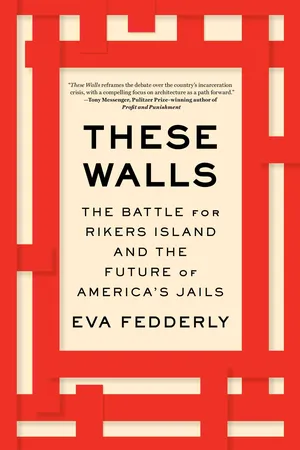
In the tradition of Locking Up Our Own and The New Jim Crow, a rarely seen, thought-provoking journey into Rikers Island and the American justice system that “reframes the debate the country’s incarceration crisis, with a compelling focus on architecture as a path forward (Tony Messenger, Pulitzer Prize–winning author of Profit and Punishment).
For nearly a century, the Rikers Island jail complex has stood on a 413-acre manmade island in the East River of New York. Today it is the largest correctional facility in the city, housing eight active jails and thousands of incarcerated individuals who have not yet been tried. It is also one of the most controversial and notorious jails in America.
Which is why, when mayor Bill de Blasio announced in 2017 that Rikers would be closed within the next decade, replaced with four newly designed jails located within the city boroughs, the surface reaction seemed largely positive. Many were enthusiastic, including Eva Fedderly, a journalist focused on the intersections of social justice and design, who was covering the closure and its impact for Architectural Digest. But as Fedderly dug deeper and spoke to more people involved, she discovered that the consensus was hardly universal. Among architects tasked with redesigns that reconcile profits and progress, the members of law enforcement working to stop incarceration cycles in community hot spots, the reformers and abolitionists calling for change, and, most wrenchingly, the incarcerated and formerly incarcerated people whose lives will be most affected, some agreed that closing Rikers was a step in the right direction, but many were quick to point out that Rikers was being replaced, not removed. On one point, however, there was firm agreement: whatever the outcome, the world would be watching.
Part on-the-ground reporting, part deep social and architectural history, These Walls is an eye-opening, “insightful…bracing look at how the nation’s jails—and the nation itself—ought to be reformed” (Kirkus Reviews) and a challenge to our long-held beliefs about what constitutes power and justice.
- 224 pages
- English
- ePUB (mobile friendly)
- Available on iOS & Android
eBook - ePub
About this book
Information
Subtopic
North American HistoryIndex
Social SciencesTable of contents
- Cover
- Title Page
- Dedication
- Author’s Note
- Epigraph
- Chapter One: Rikers Island
- Chapter Two: Imprisonment
- Chapter Three: The Justice Architects
- Chapter Four: The Incarcerated
- Chapter Five: Law Enforcement
- Chapter Six: An “Award-Winning” Jail
- Chapter Seven: The Bureaucrats
- Chapter Eight: The Neighbors
- Chapter Nine: The Prison Abolitionists
- Chapter Ten: The Future
- Acknowledgments
- About the Author
- Notes
- Copyright
Trusted by 375,005 students
Access to over 1.5 million titles for a fair monthly price.
Study more efficiently using our study tools.
Frequently asked questions
Yes, you can cancel anytime from the Subscription tab in your account settings on the Perlego website. Your subscription will stay active until the end of your current billing period. Learn how to cancel your subscription
No, books cannot be downloaded as external files, such as PDFs, for use outside of Perlego. However, you can download books within the Perlego app for offline reading on mobile or tablet. Learn how to download books offline
Perlego offers two plans: Essential and Complete
- Essential is ideal for learners and professionals who enjoy exploring a wide range of subjects. Access the Essential Library with 800,000+ trusted titles and best-sellers across business, personal growth, and the humanities. Includes unlimited reading time and Standard Read Aloud voice.
- Complete: Perfect for advanced learners and researchers needing full, unrestricted access. Unlock 1.5M+ books across hundreds of subjects, including academic and specialized titles. The Complete Plan also includes advanced features like Premium Read Aloud and Research Assistant.
We are an online textbook subscription service, where you can get access to an entire online library for less than the price of a single book per month. With over 1.5 million books across 990+ topics, we’ve got you covered! Learn about our mission
Look out for the read-aloud symbol on your next book to see if you can listen to it. The read-aloud tool reads text aloud for you, highlighting the text as it is being read. You can pause it, speed it up and slow it down. Learn more about Read Aloud
Yes! You can use the Perlego app on both iOS and Android devices to read anytime, anywhere — even offline. Perfect for commutes or when you’re on the go.
Please note we cannot support devices running on iOS 13 and Android 7 or earlier. Learn more about using the app
Please note we cannot support devices running on iOS 13 and Android 7 or earlier. Learn more about using the app
Yes, you can access These Walls by Eva Fedderly in PDF and/or ePUB format, as well as other popular books in Social Sciences & North American History. We have over 1.5 million books available in our catalogue for you to explore.