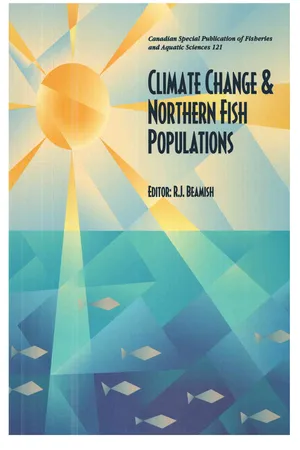
A summary of 57 studies and six poster sessions related to evidence of climate change, and its effects on freshwater and marine aquatic environments and on the dynamics of fish populations and fisheries. Numerous examples of the relationships between fish abundance trends and the environment are included. Most investigations are from the North Pacific Ocean, but studies done in the North Atlantic Ocean, the Bering Sea, the Yellow Sea, and selected freshwater lakes are also included. The effect of climate change on cod, pollock, salmon, herring, Dungeness crab, Japanese sardine, and Californian anchovy (among others) is discussed. A list of contributors is included.
eBook - PDF
About this book
Information
Topic
Biological SciencesIndex
Biological SciencesTable of contents
- Cover
- Title page
- Copyright
- Contents
- Abstract/Résumé
- Sponsors, Coordinating Committee, Steering Committee
- List of Contributors
- Acknowledgements
- Introduction - The need to understand the realtionship between climate and the dynamics of fish popluations
- Opening Remarks
- Keynote Address
- Banquet Address
- TOPIC l. Evidence for Changes in Climate and the Resulting Effects in Freshwater and Marine Environments
- Decadal coupled atmosphere-ocean variations in the North Pacific Ocean
- Long-term variations in SST fields of the North Pacific Ocean
- The effects of climate on the year-class variations of certain freshwater fish species
- Atmospheric teleconnections and cherent fluctuations in recruitment to North Atlantic cod (Gadus morhua) stocks
- Predicted effects of global climate change on fishes in Minnesota lakes
- Climate change and variability of the Bering Sea current system
- Decadal-scale variations in the eastern subarctic Pacific: I. Winter ocean conditions
- Influence of interannual changes in ocean conditions on the abundance of walleye pollock (Theragra chalcogamma) in the eastern Bering Sea
- Effects of climate change on reasource populations in the Yellow Sea ecosystem
- Analysis of trends in primary productivity and chlorophyll-a over two decades at Ocean Station P (50ºN, 145ºW) in the subarctic northeast Pacific Ocean
- Do cyclic temperatures cause cyclic fisheries?
- Sea-ice conditions and the distribution of walleye pollock (Theragra chalcogramma) on the Bering and Chukchi Sea Shelf
- Factors limiting the distributions of Ontario's freshwater fishes: the role of climate and other variables, and the potential impacts of climate change
- The El Niño of 1983 as reflected in the ichthyoplankton off Washington, Oregon, and northern California
- A comparative study of climate changes in the North Pacific and North Atlantic and their relation to the abundance of fish stocks
- TOPIC 2 Effects of climate change on fish populations and fisheries
- Fish stock fluctuations as indicators of multidecadal fluctuations in the biological productivity of the ocean
- Use of Arrhenius modelss to describe temperature dependance of organismal rates in fish
- An exploratory analysis of associations between biotic and abiotic factors and year-class strength of Gulf of Alaska walleye pollock (Theragra chalcogramma), and the reproductive performance and diets of seabirds at the Pribilof Islands, southeastern Berinf Sea
- Size decline and older age at maturity of two chum salmon (Oncorhynchus keta) stocks in western North America, 1972-92
- The difficulty of tracing the effects of climate change on the fishes of Lake Constance
- Potential influence of North Pacific sea-surface temperatures on increased production of chum salmon (Oncorhynchus keta) from Japan
- Effect of climate on herring (Clupea pallasi) population dynammics in the Northeast Pacific Ocean
- Potential effects of global climate change on Dungeness crab (Cancer magister) populations in the northeastern Pacific Ocean
- Long-term variations in the oceanic environment of the East China Sea and their influence on fisheries resources
- The relationship of several environmental indices to the survival of juvenile male nothern fur seals (Callorhinus uarsinus) from the Pribilof Islands
- Interdecadal variability in distribution and catch rates of epipelagic nekton in Northeast Pacific Ocean
- Climate change and salmon production in the Northeast Pacific Ocean
- Decadal-scale variations in the eastern subarctic Pacific: II. Response of Northeast Pacific fish stocks
- Influence of enviroment on stock fluctuations of Japanese sardine, Sardinops melanostictus
- Influence of climatic changes on succession processes in the community of neritic pelagic fishes in the Kuroshio-Oyashio zone
- Wind climate and foraging of larval and juvenile Arcto-Norwegian cod (Gadus morhua)
- Moderate is better: exploring nonlinear climatic effects on the Californian nothern anchovy (Engraulis mordax)
- The relationships amoung sea-surface temperature, the abundance of juvenile walleye pollock (Theragra chalcogramma), and the peroductie performance and diets of seabirds at the Pribilof Islands, southeastern Berring Sea
- Climate change and ocean energetics of Freaser River sockeye salmon (Oncorhychus nerka)
- High-latitude climate forcing and todal mixing by the 18.6-year lunar nodal cycle and low-frequency recruitment trends in Pacific hailbut (Hippoklossus stenolepis)
- Marine climate off Newfoundland and its influence in Atlantic salmon (Salmo salar) and capelin (Mallotus villosus)
- The effect of climate on North Pacific pink salmon (Oncorhynchus gorbuscha) production: examining some details of a natural experiment
- APPRISE: A multi-year investigation of environmental variation and its effects on larval recruitment
- A paleoscience approach to estimating the effects of climatic warming on salmonid fisheries on the Columbian River basin
- Relation of eastern Bering Sea walleye pollock (Theragra chalcogramma) recruitment to environmental and oceanographic variables
- Climate-included changes Pacific hake (Merluccius products) bundance and pelagic community interactions in the Vancouver Island upwelling system
- The impacts of climate change on Japanese fisheries
- The extent of the effect of climate upon fisheries of Russia
- Influence of climate change on living resources in the offshore waters of China
- Warm and cool water stocks of Pacific cod (Gadus macrocephalus): a comparative study of reproductive biology and stock dynamics
- Influence of wind-induced currents on the recruitment of Japanese sardine(Sardinops melanostictus) eggs and larvae
- Variations in abdunace of pelagic fishes in the Kuroshio Zone as related to climatic changes
- Food web theory, marine food webs, and what climate change may do to northern marine fish populations
- Environmental effects on long-term population dynamics and recruitment to Pacific herring (Clupea pallasi) populations in southern British Columbia
- Marine fish production trends off the Pacific coast of Canada and the United States
- Trends in the average size of Pacific coast Canadian catches
- Interannual variability of the zooplankton community off southern Vancouver Island
- Growth and recruitment of freshwater drum (Aplodintus grunniens) as related to long-term temperature patterns
- Biomass variations of walleye pollock of the Bering Sea in relation to oceanological conditions
- Influence of climate on recruitment and migration of fish stocks in the North Sea
- Effect of water temperature on emigration timing and size of Fraser River pink salmon (Oncorhychus gorbuscha) fry: implications for marine survival
- Variability in frontal boundaries, temperatures, and the geographic ranges of species and pelagic marine communities along 175º30'E, 1978-91
- Change in the distribution of favourable water temperatures and migration of Japanese sardine (Sardinops melanostictus)
- Climate-dependent salmon and sardine stock fluctuations in the North Pacific
- Larval fish growth in the Barents Sea
- Potential impact of climate change on the habitat and population dynamics of juvenile Atlantic salmon
- Potential to index climate with growth and recruitment of temperate fish
- Modeling the impact of climate variability on the advection of larval walleye pollock (Theragra chalcogramma) in the Gulf of Alaska
- Fisheries sciences and climate change
- Fisheries management and climate change
- Large-scale atmospheric anomalies and climate change
- Symposium summary
- Back cover
Trusted by 375,005 students
Access to over 1.5 million titles for a fair monthly price.
Study more efficiently using our study tools.
Frequently asked questions
Yes, you can cancel anytime from the Subscription tab in your account settings on the Perlego website. Your subscription will stay active until the end of your current billing period. Learn how to cancel your subscription
No, books cannot be downloaded as external files, such as PDFs, for use outside of Perlego. However, you can download books within the Perlego app for offline reading on mobile or tablet. Learn how to download books offline
Perlego offers two plans: Essential and Complete
- Essential is ideal for learners and professionals who enjoy exploring a wide range of subjects. Access the Essential Library with 800,000+ trusted titles and best-sellers across business, personal growth, and the humanities. Includes unlimited reading time and Standard Read Aloud voice.
- Complete: Perfect for advanced learners and researchers needing full, unrestricted access. Unlock 1.5M+ books across hundreds of subjects, including academic and specialized titles. The Complete Plan also includes advanced features like Premium Read Aloud and Research Assistant.
We are an online textbook subscription service, where you can get access to an entire online library for less than the price of a single book per month. With over 1.5 million books across 990+ topics, we’ve got you covered! Learn about our mission
Look out for the read-aloud symbol on your next book to see if you can listen to it. The read-aloud tool reads text aloud for you, highlighting the text as it is being read. You can pause it, speed it up and slow it down. Learn more about Read Aloud
Yes! You can use the Perlego app on both iOS and Android devices to read anytime, anywhere — even offline. Perfect for commutes or when you’re on the go.
Please note we cannot support devices running on iOS 13 and Android 7 or earlier. Learn more about using the app
Please note we cannot support devices running on iOS 13 and Android 7 or earlier. Learn more about using the app
Yes, you can access Climate Change & Northern Fish Populations by in PDF and/or ePUB format. We have over 1.5 million books available in our catalogue for you to explore.