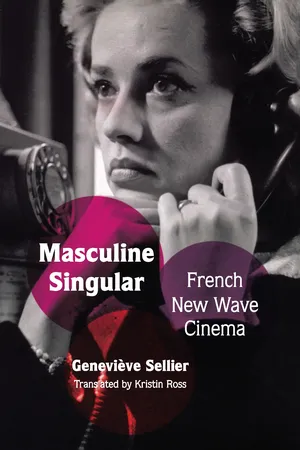
Masculine Singular
eBook - PDF

Masculine Singular

French New Wave Cinema

,
  1. 280 pages
  2. English
  3. PDF
  4. Available on iOS & Android
eBook - PDF

Masculine Singular

French New Wave Cinema

,

About this book

Masculine Singular is an original interpretation of French New Wave cinema by one of France's leading feminist film scholars. While most criticism of the New Wave has concentrated on the filmmakers and their films, Geneviève Sellier focuses on the social and cultural turbulence of the cinema's formative years, from 1957 to 1962. The New Wave filmmakers were members of a young generation emerging on the French cultural scene, eager to acquire sexual and economic freedom. Almost all of them were men, and they "wrote" in the masculine first-person singular, often using male protagonists as stand-ins for themselves. In their films, they explored relations between men and women, and they expressed ambivalence about the new liberated woman. Sellier argues that gender relations and the construction of sexual identities were the primary subject of New Wave cinema.

Sellier draws on sociological surveys, box office data, and popular magazines of the period, as well as analyses of specific New Wave films. She examines the development of the New Wave movement, its sociocultural and economic context, and the popular and critical reception of such well-known films as Jules et Jim and Hiroshima mon amour. In light of the filmmakers' focus on gender relations, Sellier reflects on the careers of New Wave's iconic female stars, including Jeanne Moreau and Brigitte Bardot. Sellier's thorough exploration of early New Wave cinema culminates in her contention that its principal legacy—the triumph of a certain kind of cinephilic discourse and of an "auteur theory" recognizing the director as artist—came at a steep price: creativity was reduced to a formalist game, and affirmation of New Wave cinema's modernity was accompanied by an association of creativity with masculinity.

Frequently asked questions

Yes, you can cancel anytime from the Subscription tab in your account settings on the Perlego website. Your subscription will stay active until the end of your current billing period. Learn how to cancel your subscription.
At the moment all of our mobile-responsive ePub books are available to download via the app. Most of our PDFs are also available to download and we're working on making the final remaining ones downloadable now. Learn more here.
Perlego offers two plans: Essential and Complete
  • Essential is ideal for learners and professionals who enjoy exploring a wide range of subjects. Access the Essential Library with 800,000+ trusted titles and best-sellers across business, personal growth, and the humanities. Includes unlimited reading time and Standard Read Aloud voice.
  • Complete: Perfect for advanced learners and researchers needing full, unrestricted access. Unlock 1.4M+ books across hundreds of subjects, including academic and specialized titles. The Complete Plan also includes advanced features like Premium Read Aloud and Research Assistant.
Both plans are available with monthly, semester, or annual billing cycles.
We are an online textbook subscription service, where you can get access to an entire online library for less than the price of a single book per month. With over 1 million books across 1000+ topics, we’ve got you covered! Learn more here.
Look out for the read-aloud symbol on your next book to see if you can listen to it. The read-aloud tool reads text aloud for you, highlighting the text as it is being read. You can pause it, speed it up and slow it down. Learn more here.
Yes! You can use the Perlego app on both iOS or Android devices to read anytime, anywhere — even offline. Perfect for commutes or when you’re on the go.
Please note we cannot support devices running on iOS 13 and Android 7 or earlier. Learn more about using the app.
Yes, you can access Masculine Singular by in PDF and/or ePUB format. We have over one million books available in our catalogue for you to explore.

Information

Table of contents

  1. Contents
  2. Acknowledgments
  3. Introduction: The Aesthetic Doxa on the New Wave
  4. Chapter One: A New Generation Marked by the Emergence of Women
  5. Chapter Two: Cinephilia in the 1950s
  6. Chapter Three: Auteur Cinema: An Affair of State
  7. Chapter Four: Contrasting Receptions
  8. Chapter Five: The Precursors
  9. Chapter Six: Between Romanticism and Modernism
  10. Chapter Seven: Nostalgia for a Heroic Masculinity
  11. Chapter Eight: The Women of the New Wave: Between Modern and Archaic
  12. Chapter Nine: Jeanne Moreau: Star of the New Wave and Icon of Modernity
  13. Chapter Ten: Brigitte Bardot and the New Wave: An Ambivalent Relationship
  14. Chapter Eleven: The Independent Filmmakers of the Left Bank:A ‘‘Feminist’’ Alternative?
  15. Conclusion: The New Wave’s Legacy: ‘‘Auteur Cinema’’
  16. Appendix One: Box Office Results
  17. Appendix Two: The Press
  18. Notes
  19. Bibliography
  20. Index