Poplar is increasingly recognized as an excellent model tree for the study of tree growth and its underlying physiology and genetics. By studying trees of the genus Populus (poplars, cottonwoods, aspens), which in their native ecosystems play a major role in the re-colonization of sites after disturbances, new insights have been gained into plantation culture and the development of improved cultivars. Of the 20 chapters in this publication, editored by an international group of researchers, one section deals with systematics, genetics, genetic manipulation and biotic interactions of Populus, while the other deals with stress response and the physiology of growth and productivity.
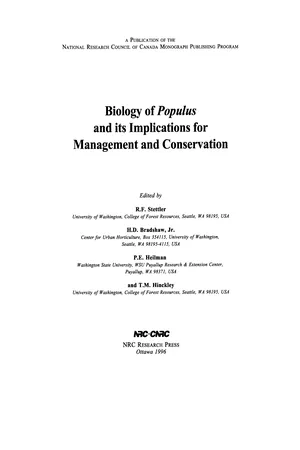
- 554 pages
- English
- PDF
- Available on iOS & Android
eBook - PDF
About this book
Information
Topic
Biological SciencesIndex
Biological SciencesTable of contents
- Cover
- Abstract/Résumé
- Preface
- PART I. Evolution, genetics, and genetic manipulation. Overview
- CHAPTER 1. Systematics and evolution of Populus
- CHAPTER 2. The genecology of Populus
- CHAPTER 3. Life history, ecology, and conservation of riparian cottonwoods in North America
- CHAPTER 4. The role hybirdization in the genetic manipulation of Populus
- CHAPTER 5. Controlled reproduction of Populus
- CHAPTER 6. Popular breeding and selection strategies
- CHAPTER 7. Quantitative genetics of poplars and poplar hybirds
- CHAPTER 8. Molecular genetics of Populus
- CHAPTER 9. Cellular and molecular biology of Agrobacterium-mediated transformation of plants and its application to genetic transformation of Populus
- CHAPTER 10. The specificity of fungal pathogens of Populus
- CHAPTER 11. Ecological and evolutionary implications of hybirdization: Populus–herbivore interactions
- PART II. Physiology of growth, productivity, and stress response
- CHAPTER 12. Leaf growth physiology
- CHAPTER 13. Physiology of secondary tissues of populus
- CHAPTER 14. The structre and functon of Populus root systems
- CHAPTER 15. Carbon aquisition and allocation
- CHAPTER 16. Water relations
- CHAPTER 17. Stress physiology — abiotics
- CHAPTER 18. Production physiology
- CHAPTER 19. Linking physiology, molecular genetics, and the Populus ideotype
- CHAPTER 20. Trends in poplar culture: some global and regional perspectives
- Back cover
Trusted by 375,005 students
Access to over 1.5 million titles for a fair monthly price.
Study more efficiently using our study tools.
Frequently asked questions
Yes, you can cancel anytime from the Subscription tab in your account settings on the Perlego website. Your subscription will stay active until the end of your current billing period. Learn how to cancel your subscription
No, books cannot be downloaded as external files, such as PDFs, for use outside of Perlego. However, you can download books within the Perlego app for offline reading on mobile or tablet. Learn how to download books offline
Perlego offers two plans: Essential and Complete
- Essential is ideal for learners and professionals who enjoy exploring a wide range of subjects. Access the Essential Library with 800,000+ trusted titles and best-sellers across business, personal growth, and the humanities. Includes unlimited reading time and Standard Read Aloud voice.
- Complete: Perfect for advanced learners and researchers needing full, unrestricted access. Unlock 1.5M+ books across hundreds of subjects, including academic and specialized titles. The Complete Plan also includes advanced features like Premium Read Aloud and Research Assistant.
We are an online textbook subscription service, where you can get access to an entire online library for less than the price of a single book per month. With over 1.5 million books across 990+ topics, we’ve got you covered! Learn about our mission
Look out for the read-aloud symbol on your next book to see if you can listen to it. The read-aloud tool reads text aloud for you, highlighting the text as it is being read. You can pause it, speed it up and slow it down. Learn more about Read Aloud
Yes! You can use the Perlego app on both iOS and Android devices to read anytime, anywhere — even offline. Perfect for commutes or when you’re on the go.
Please note we cannot support devices running on iOS 13 and Android 7 or earlier. Learn more about using the app
Please note we cannot support devices running on iOS 13 and Android 7 or earlier. Learn more about using the app
Yes, you can access Biology of Populus and its Implications for Management and Conservation by in PDF and/or ePUB format. We have over 1.5 million books available in our catalogue for you to explore.