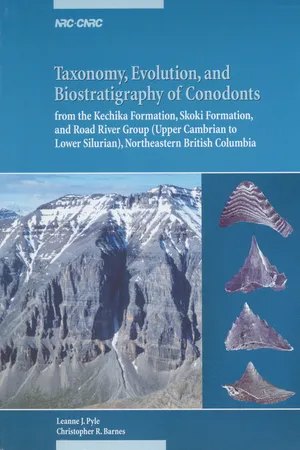
Conodonts, the tiny, phosphatic, toothlike remains of an extinct group of early vertebrates, are the most important fossil group for biostratigraphy throughout their stratigraphic range from Late Cambrian to Late Triassic. The monograph presents the results of a significant project in remote regions of northeastern British Columbia. It extends the knowledge of the stratigraphic framework and conodont faunas into a region where information of this kind is largely unknown. Complete stratigraphic sections exposed in the high alpine of the Northern Rocky Mountains allowed examination of strata across a platform-shelfbreak-basin transect. The conodont faunas from the Kechika Formation, Skoki Formation, and Road River Group are described from an extensive collection of nine stratigraphic sections (over 9000 m measured) that yielded abundant conodont elements (38 600 total). This monograph represents a benchmark study of these important zonal fossils. The detailed paleontological work not only provides a taxonomic basis for future studies on early Paleozoic conodonts but also focuses on the evolution of conodonts in the early Ordovician, a time of extraordinary adaptive radiation. The taxonomic work provides detailed descriptions and illustrations of 185 species representing 69 genera. Seven new genera and 39 new species are described. The high diversity of taxa across the platform-to-basin transect shows the biogeographic differentiation and spatial ecological partitioning of conodonts through time. The taxonomy permits the refinement to the biostratigraphic zonation within two faunal realms for British Columbia that can be correlated with schemes elsewhere in North America and also internationally.
- 243 pages
- English
- PDF
- Available on iOS & Android
eBook - PDF
About this book
Information
Topic
Biological SciencesIndex
Biological SciencesTable of contents
- Cover
- Half title page
- Publisher
- Title page
- Copyright
- Contents
- Abstract / Résumé
- Acknowledgements
- Introduction
- Lithostratigraphy
- Biostratigraphy
- Discussion of key evolutionary lineages
- Systematic paleontology
- Taxa of unknown affinity
- References
- Appendix A
- Appendix B
- Plates
- Back cover
Trusted by 375,005 students
Access to over 1.5 million titles for a fair monthly price.
Study more efficiently using our study tools.
Frequently asked questions
Yes, you can cancel anytime from the Subscription tab in your account settings on the Perlego website. Your subscription will stay active until the end of your current billing period. Learn how to cancel your subscription
No, books cannot be downloaded as external files, such as PDFs, for use outside of Perlego. However, you can download books within the Perlego app for offline reading on mobile or tablet. Learn how to download books offline
Perlego offers two plans: Essential and Complete
- Essential is ideal for learners and professionals who enjoy exploring a wide range of subjects. Access the Essential Library with 800,000+ trusted titles and best-sellers across business, personal growth, and the humanities. Includes unlimited reading time and Standard Read Aloud voice.
- Complete: Perfect for advanced learners and researchers needing full, unrestricted access. Unlock 1.5M+ books across hundreds of subjects, including academic and specialized titles. The Complete Plan also includes advanced features like Premium Read Aloud and Research Assistant.
We are an online textbook subscription service, where you can get access to an entire online library for less than the price of a single book per month. With over 1.5 million books across 990+ topics, we’ve got you covered! Learn about our mission
Look out for the read-aloud symbol on your next book to see if you can listen to it. The read-aloud tool reads text aloud for you, highlighting the text as it is being read. You can pause it, speed it up and slow it down. Learn more about Read Aloud
Yes! You can use the Perlego app on both iOS and Android devices to read anytime, anywhere — even offline. Perfect for commutes or when you’re on the go.
Please note we cannot support devices running on iOS 13 and Android 7 or earlier. Learn more about using the app
Please note we cannot support devices running on iOS 13 and Android 7 or earlier. Learn more about using the app
Yes, you can access Taxonomy, Evolution, and Biostratigraphy of Conodonts by in PDF and/or ePUB format. We have over 1.5 million books available in our catalogue for you to explore.