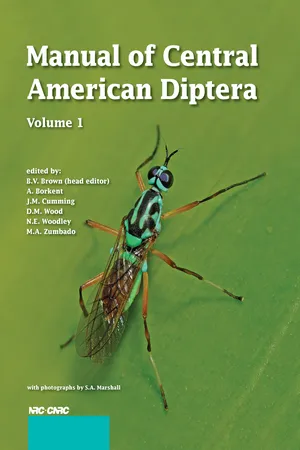
True flies, or Diptera, are an exceedingly diverse and tremendously important group of animals not only because of their impact on human health, but also because of their varied roles as decomposers, herbivores, predators and parasites of other animals. This two-volume book, a collaboration of over 70 experts on Diptera, is the first-ever resource for the identification and understanding of Central American flies. Together, the two volumes treat all 106 families of flies found in the region, including discussions of biology, economic importance, classification, identification to the genus level as well as a synopsis of each genus. In a time of major ecosystem destruction, this work provides the basis for understanding the biodiversity of one of the major orders of insects in a large tropical region. It will be the foundation for future taxonomic studies for decades to come. Volume 1 covers 42 of the 106 families of flies - sometimes termed the Lower Diptera - and includes introductory chapters dealing with morphology and terminology, natural history, economic importance and phylogeny of Diptera as well as keys to all the Central American fly families for both the adult and larval stages. The text is accompanied by over 1500 line drawings and 144 color photographs of flies.
eBook - PDF
About this book
Information
Topic
Biological SciencesIndex
Biological SciencesTable of contents
- Cover
- Inside front cover
- Title page
- Copyright
- Table of contents
- Acknowledgments
- Authors of Volume 1
- Figure credits for Volume 1
- FOREWORD
- INTRODUCTION
- ADULT MORPHOLOGY AND TERMINOLOGY
- NATURAL HISTORY
- ECONOMIC IMPORTANCE OF DIPTERA
- PHYLOGENY OF THE DIPTERA
- KEY TO DIPTERA FAMILIES — ADULTS
- KEY TO DIPTERA FAMILIES — LARVAE
- TIPULIDAE (crane flies, tipúlidos)
- BLEPHARICERIDAE (net-winged midges)
- BIBIONIDAE (march flie s, love-bugs)
- DITOMYIIDAE (DITOMYIID FUNGUS GNATS)
- DIADOCIDIIDAE (DIADOCIDIID FUNGUS GNATS)
- KEROPLATIDAE (PREDACEOUS FUNGUS GNATS)
- LYGISTORRHINIDAE (LONG-BEAKED FUNGUS GNATS)
- MYCETOPHILIDAE (fungus gnats)
- SCIARIDAE (black fungus gnats)
- CECIDOMYIIDAE (gall midges)
- OHAKUNEA GROUP (Sciaro idea, unass ignedto family; no common name)
- PSYCHODIDAE (sand flies, and moth flies or owl flies)
- TRICHOCERIDAE (winter crane flies)
- ANISOPODIDAE (woodgnats or window gnats)
- SCATOPSIDAE (minute blackscavenger flies)
- PTYCHOPTERIDAE (phantomcrane flies)
- DIXIDAE (meniscus mid ges)
- CORETHRELLIDAE (frog-biting midges)
- CHAOBORIDAE (pha ntom mid ges)
- CULICIDAE (mosquitos, zancudos)
- SIMULIIDAE (blackflies, bocones)
- CERATOPOGONIDAE (biting midges, purrujas)
- CHIRONOMIDAE (non-biting midges)
- VERMILEONIDAE (worm-lions)
- RHAGIONIDAE (snipe flies)
- ATHERICIDAE (athericid flies)
- TABANIDAE (horse flies, deer flies, tabanos)
- XYLOPHAGIDAE (xylophagid flies)
- PANTOPHTHALMIDAE (pantophthalmid flies)
- XYLOMYIDAE (xylomyid flies)
- STRATIOMYIDAE (soldier flies)
- ACROCERIDAE (spider flies, small-headed flies)
- NEMESTRINIDAE (tangle-veined flies)
- MYTHICOMYIIDAE (micro bee flies)
- BOMBYLIIDAE (bee flies)
- APIOCERIDAE (apiocerid flies)
- MYDIDAE (mydas flies)
- ASILIDAE (robber flies, assassin flies, moscas cazadoras, moscas ladronas)
- THEREVIDAE (stiletto flies)
- SCENOPINIDAE (window flies)
- EMPIDIDAE (dance flies, balloon flies, predaceous flies)
- DOLICHOPODIDAE (long-legged flies)
- TAXONOMIC INDEX TO VOLUME 1
- Back cover
Trusted by 375,005 students
Access to over 1.5 million titles for a fair monthly price.
Study more efficiently using our study tools.
Frequently asked questions
Yes, you can cancel anytime from the Subscription tab in your account settings on the Perlego website. Your subscription will stay active until the end of your current billing period. Learn how to cancel your subscription
No, books cannot be downloaded as external files, such as PDFs, for use outside of Perlego. However, you can download books within the Perlego app for offline reading on mobile or tablet. Learn how to download books offline
Perlego offers two plans: Essential and Complete
- Essential is ideal for learners and professionals who enjoy exploring a wide range of subjects. Access the Essential Library with 800,000+ trusted titles and best-sellers across business, personal growth, and the humanities. Includes unlimited reading time and Standard Read Aloud voice.
- Complete: Perfect for advanced learners and researchers needing full, unrestricted access. Unlock 1.5M+ books across hundreds of subjects, including academic and specialized titles. The Complete Plan also includes advanced features like Premium Read Aloud and Research Assistant.
We are an online textbook subscription service, where you can get access to an entire online library for less than the price of a single book per month. With over 1.5 million books across 990+ topics, we’ve got you covered! Learn about our mission
Look out for the read-aloud symbol on your next book to see if you can listen to it. The read-aloud tool reads text aloud for you, highlighting the text as it is being read. You can pause it, speed it up and slow it down. Learn more about Read Aloud
Yes! You can use the Perlego app on both iOS and Android devices to read anytime, anywhere — even offline. Perfect for commutes or when you’re on the go.
Please note we cannot support devices running on iOS 13 and Android 7 or earlier. Learn more about using the app
Please note we cannot support devices running on iOS 13 and Android 7 or earlier. Learn more about using the app
Yes, you can access Manual of Central American Diptera by in PDF and/or ePUB format. We have over 1.5 million books available in our catalogue for you to explore.