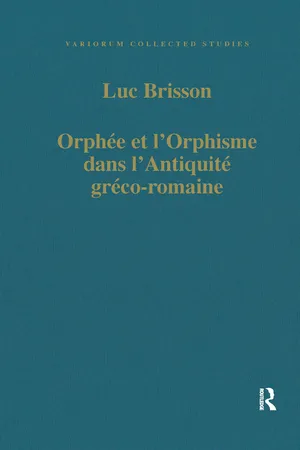
The figure of Orpheus has long exercised a potent influence on religious thought. Yet what we know directly about Orphism comes from a scatter of isolated and often very short fragments quoted in the works of Platonists of the Roman period, notably Proclus, Damascius and Olympiodorus. The author's concern here is to establish the context in which these passages were cited, and to trace the development of the written tradition, from the texts which contain a critique of the beliefs of the Homeric era to those, whether newly composed or transformed, which show signs of adaptation to later religious and philosophical movements, among them Stoicism and Platonism. In sharp contrast to views held by others, it is argued that it is possible to map out a process of evolution, amongst other criteria by focusing on the role and place of Chronos in the Orphic theogony. The author also asks whether there really ever existed true Orphic sects with a cult with specific rites, and would conclude that the present evidence cannot be held to substantiate this. Orphée a pendant longtemps exercé une puissante influence sur la pensée religieuse. Cependant, ce que nous connaissons directement de l'Orphïsme se réduit à une poignée de fragments isolés et souvent très courts qui se trouvent éparpillés dans les oeuvres de Platoniciens ayant vécu sous l'Empire romain, surtout Proclus, Damascius et Olympiodore. Dans les articles qui composent ce recueil, l'auteur s'est attaché à reconstituer les contextes dans lesquels ces passages sont cités, et à comprendre comment s'est développée la tradition écrite à laquelle ils appartiennent, depuis les textes qui critiquent les croyances véhiculées par Homère et par Hésiode et qui, ayant fait l'objet d'une rédaction ou d'une transformation récente, présentent les signes d'une adaptation à des mouvements religieux ou philosophiques tardifs, le Stoïcisme et le médio-Platonisme entre autres. S'opposant en cela à b
- 312 pages
- English
- PDF
- Available on iOS & Android
eBook - PDF
Orphée et l'Orphisme dans l'Antiquité gréco-romaine
About this book
Trusted by 375,005 students
Access to over 1.5 million titles for a fair monthly price.
Study more efficiently using our study tools.
Information
Table of contents
- Cover
- Series Page
- Half Title
- Title Page
- Copyright Page
- Table of Contents
- Note de L'éditeur
- Avant-propos
- Introduction
- Chapter I: Les théogonies Orphiques et le papyrus de Derveni: notes critiques
- Chapter II: Usages et fonctions du secret dans le Pythagorisme ancien
- Chapter III: La figure de Chronos dans la théogonie orphique et ses antécédents iraniens
- Chapter IV: Orphée et l'Orphisme à l'époque impériale: témoignages et interprétations philosophiques, de Plutarque à Jamblique
- Chapter V: Proclus et l'Orphisme
- Chapter VI: Damascius et l'Orphisme
- Chapter VII: Le corps «dionysiaque»: l'anthropogonie décrite dans le Commentaire sur le Phédon de Platon (1, par. 3-6), attribué à Olympiodore est-elle orphique?
- Addenda et corrigenda
- Index locorum
- Index des noms propres anciens
- Index des concepts
- Index des termes grecs
Frequently asked questions
Yes, you can cancel anytime from the Subscription tab in your account settings on the Perlego website. Your subscription will stay active until the end of your current billing period. Learn how to cancel your subscription
No, books cannot be downloaded as external files, such as PDFs, for use outside of Perlego. However, you can download books within the Perlego app for offline reading on mobile or tablet. Learn how to download books offline
Perlego offers two plans: Essential and Complete
- Essential is ideal for learners and professionals who enjoy exploring a wide range of subjects. Access the Essential Library with 800,000+ trusted titles and best-sellers across business, personal growth, and the humanities. Includes unlimited reading time and Standard Read Aloud voice.
- Complete: Perfect for advanced learners and researchers needing full, unrestricted access. Unlock 1.5M+ books across hundreds of subjects, including academic and specialized titles. The Complete Plan also includes advanced features like Premium Read Aloud and Research Assistant.
We are an online textbook subscription service, where you can get access to an entire online library for less than the price of a single book per month. With over 1.5 million books across 990+ topics, we’ve got you covered! Learn about our mission
Look out for the read-aloud symbol on your next book to see if you can listen to it. The read-aloud tool reads text aloud for you, highlighting the text as it is being read. You can pause it, speed it up and slow it down. Learn more about Read Aloud
Yes! You can use the Perlego app on both iOS and Android devices to read anytime, anywhere — even offline. Perfect for commutes or when you’re on the go.
Please note we cannot support devices running on iOS 13 and Android 7 or earlier. Learn more about using the app
Please note we cannot support devices running on iOS 13 and Android 7 or earlier. Learn more about using the app
Yes, you can access Orphée et l'Orphisme dans l'Antiquité gréco-romaine by Luc Brisson in PDF and/or ePUB format. We have over 1.5 million books available in our catalogue for you to explore.