- 334 pages
- English
- PDF
- Available on iOS & Android
eBook - PDF
About this book
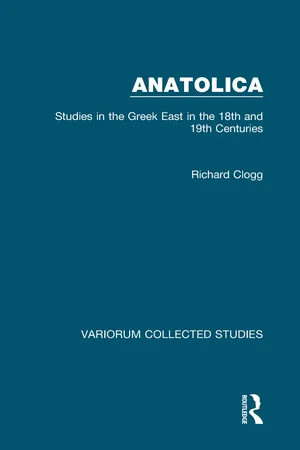
Until 1923 there were large Greek populations outside the boundaries of the Greek state in many areas of the Near and Middle East. These constituted what the Greeks term I kath'imas Anatoli ('our East') and were the focus for the Megali Idea, the 'Great Idea' of incorporating the Greeks of the region within a single state, with Constantiople as its capital. Professor Clogg deals here with the history of this Greek East in the 18th and 19th centuries and at the same time makes a contribution to the study of the Ottoman world within which they lived. The opening articles examine how these communities were defined, in religious terms (many were Turkish-speaking), and their organisation as part of the Ottoman system of government. Further studies then look at factors, economic, intellectual and messianic, which contributed to the emergence of the Greek state and its expansionist aspirations, and at aspects of religious history, including Protestant missionary activity and the Orthodox reaction to Enlightenment thought.
Table of contents
- Cover
- Series Page
- Half Title
- Title Page
- Copyright Page
- Table of Contents
- Acknowledgements
- Foreword
- Map
- Chapter I: I kath’imas Anatoli: the Greek East in the eighteenth and nineteenth centuries
- Chapter II: The Greek millet in the Ottoman Empire
- Chapter III: Anadolu Hiristiyan Karindaslarimiz: the Turkish-speaking Greeks of Asia Minor
- Chapter IV: The Byzantine legacy in the modern Greek world: the Megali Idea
- Chapter V: The Dhidhaskalia Patriki (1798): an Orthodox reaction to French revolutionary propaganda
- Chapter VI: Elite and popular culture in Greece under Turkish rule
- Chapter VII: Korais and England
- Chapter VIII: Anti-clericalism in pre-independence Greece c. 1750–1821
- Chapter IX: ‘Eide ston Tourko vasilevei i adikia kai i arpagi': the Smyrna ‘rebellion’ of 1797
- Chapter X: The Greek mercantile bourgeoisie: ‘progressive’ or ‘reactionary’?
- Chapter XI: Sense of the past in pre-independence Greece
- Chapter XII: Some karamanlidika inscriptions from the Monastery of the Zoodokhos Pigi, Balikli, Istanbul
- Chapter XIII: Benjamin Barker’s journal of a tour in Thrace (1823)
- Chapter XIV: Some Protestant tracts printed at the press of the Ecumenical Patriarchate in Constantinople: 1818–1820
- Chapter XV: A little-known Orthodox neo-martyr, Athanasios of Smyrna (1819)
- Chapter XVI: The correspondence of Adhamantios Korais with the British and Foreign Bible Society
- Chapter XVII: A further note on the French newspapers of Istanbul during the revolutionary period (1795–97)
- Chapter XVIII: An attempt to revive Turkish printing in Istanbul in 1779
- Index
Trusted by 375,005 students
Access to over 1.5 million titles for a fair monthly price.
Study more efficiently using our study tools.
Frequently asked questions
Yes, you can cancel anytime from the Subscription tab in your account settings on the Perlego website. Your subscription will stay active until the end of your current billing period. Learn how to cancel your subscription
No, books cannot be downloaded as external files, such as PDFs, for use outside of Perlego. However, you can download books within the Perlego app for offline reading on mobile or tablet. Learn how to download books offline
Perlego offers two plans: Essential and Complete
- Essential is ideal for learners and professionals who enjoy exploring a wide range of subjects. Access the Essential Library with 800,000+ trusted titles and best-sellers across business, personal growth, and the humanities. Includes unlimited reading time and Standard Read Aloud voice.
- Complete: Perfect for advanced learners and researchers needing full, unrestricted access. Unlock 1.5M+ books across hundreds of subjects, including academic and specialized titles. The Complete Plan also includes advanced features like Premium Read Aloud and Research Assistant.
We are an online textbook subscription service, where you can get access to an entire online library for less than the price of a single book per month. With over 1.5 million books across 990+ topics, we’ve got you covered! Learn about our mission
Look out for the read-aloud symbol on your next book to see if you can listen to it. The read-aloud tool reads text aloud for you, highlighting the text as it is being read. You can pause it, speed it up and slow it down. Learn more about Read Aloud
Yes! You can use the Perlego app on both iOS and Android devices to read anytime, anywhere — even offline. Perfect for commutes or when you’re on the go.
Please note we cannot support devices running on iOS 13 and Android 7 or earlier. Learn more about using the app
Please note we cannot support devices running on iOS 13 and Android 7 or earlier. Learn more about using the app
Yes, you can access Anatolica by Richard Clogg in PDF and/or ePUB format, as well as other popular books in History & World History. We have over 1.5 million books available in our catalogue for you to explore.