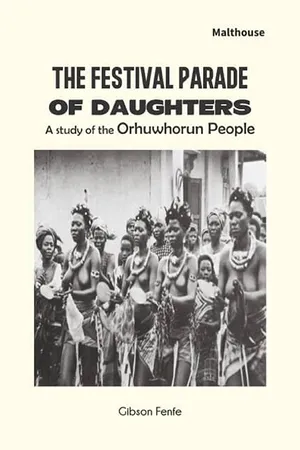
"But what I have done is to put together something which can be considered as our own. Every detail documented here is a record of past and present events as narrated by the number of people I consulted and the ones I witnessed as a child. This book is written objectively as a base for our fast-fading culture to be preserved for future generations. But my satisfaction lies in the fact that it has afforded an opportunity for our traditional history to be introduced to the public."Orhuwhorun - a prominent community with the Udu Local Government whose 2006 population is cited by Fenfe at 142, 480 - has for generations been known for an active and creative cycle of festive performances. During my years in Urhoboland, I was often directed there as I sought out towns that were continuing to maintain older customs that were unfortunately descending in popularity elsewhere. Elsewhere, Fenfe successfully takes on a most challenging task: an outline of the various migrations of groups to the site of present-day Orhuwhorun... does a fine job explaining the various town festivals, especially the Edjo festivals. Once again here he reiterates the relationship between land (Edjor-Oto) and water (Edjor-Ame) performances, writes an excellent commentary on the arrival of Christianity into Urhoboland, and the consequences that this new religion brought. His last commentary takes us to a most difficult topic: the decline of the 'old' culture. Culture is always changing, and one should not long for some sort of 'traditional' past since it actually does not exist. True, what happened in, say, 1850 was most different than that of 1900 or 1950, but the more recent changes are in many ways more devastating. This book actually offers some potential not to re-live the past, but to bring a great understanding of those ways. We hope to see more such innovative scholars, such as Gibson Fenfe, to come forward and to take on the responsibility of studying and reporting on the arts and culture of their own communities. - Prof. Perkins Foss
- 250 pages
- English
- PDF
- Available on iOS & Android
eBook - PDF
The Festival Parade of Daughters
About this book
Information
Topic
Social SciencesIndex
Social SciencesTable of contents
- Front cover
- Title page
- Copyright
- Dedication
- Acknowledgements
- Preface
- Foreword
- Glossary of Urhobo terms
- Urhobo anthem
- Orhuwhorun anthem
- Images and illustrations
- Contents
- INTRODUCTION
- 1 BRIEF HISTORY: THE URHOBO
- 2 ACCOUNT OF MIGRATION: THE ORHUWHORUN PEOPLE
- 3 THE INSTITUTION OF OKAKA MONARCHY (UVIE)
- 4 SOCIO-POLITICAL ORGANISATION
- 5 FESTIVALS
- 6 THE IGBU FESTIVAL
- 7 OMESUO R’UDUWON ORHUWHORUN (UDJE SONGS RIVALRY CONTEST)
- 8 THE ARRIVAL OF CHRISTIAN FAITH IN URHOBOLAND
- General index
- Back cover
Trusted by 375,005 students
Access to over 1.5 million titles for a fair monthly price.
Study more efficiently using our study tools.
Frequently asked questions
Yes, you can cancel anytime from the Subscription tab in your account settings on the Perlego website. Your subscription will stay active until the end of your current billing period. Learn how to cancel your subscription
No, books cannot be downloaded as external files, such as PDFs, for use outside of Perlego. However, you can download books within the Perlego app for offline reading on mobile or tablet. Learn how to download books offline
Perlego offers two plans: Essential and Complete
- Essential is ideal for learners and professionals who enjoy exploring a wide range of subjects. Access the Essential Library with 800,000+ trusted titles and best-sellers across business, personal growth, and the humanities. Includes unlimited reading time and Standard Read Aloud voice.
- Complete: Perfect for advanced learners and researchers needing full, unrestricted access. Unlock 1.5M+ books across hundreds of subjects, including academic and specialized titles. The Complete Plan also includes advanced features like Premium Read Aloud and Research Assistant.
We are an online textbook subscription service, where you can get access to an entire online library for less than the price of a single book per month. With over 1.5 million books across 990+ topics, we’ve got you covered! Learn about our mission
Look out for the read-aloud symbol on your next book to see if you can listen to it. The read-aloud tool reads text aloud for you, highlighting the text as it is being read. You can pause it, speed it up and slow it down. Learn more about Read Aloud
Yes! You can use the Perlego app on both iOS and Android devices to read anytime, anywhere — even offline. Perfect for commutes or when you’re on the go.
Please note we cannot support devices running on iOS 13 and Android 7 or earlier. Learn more about using the app
Please note we cannot support devices running on iOS 13 and Android 7 or earlier. Learn more about using the app
Yes, you can access The Festival Parade of Daughters by Gibson Fenfe in PDF and/or ePUB format. We have over 1.5 million books available in our catalogue for you to explore.