- 440 pages
- English
- ePUB (mobile friendly)
- Available on iOS & Android
About this book
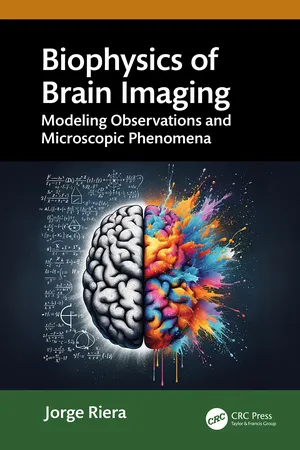
This book takes a multiscale overview and theoretical framework for all existing brain imaging modalities. It also presents technological development for data fusion and underlying biophysical models. The book also provides problems and exercises useful for undergraduate and graduate courses.
Biophysics of Brain Imaging is broken up into 3 parts. Part 1: Modeling Observations and Microscopic Phenomena provides the physical and physiological foundation of all brain imaging modalities. Part 2 (Edited): Measuring and Modeling Emergent Mesoscopic Phenomena examines recording techniques and biophysical models used today to represent the mesoscale of the brain, the voxel. Part 3: Hypothesis Testing and Applications discusses methods to analyze brain imaging data and their applications to evaluate signatures in a variety of diseases, e.g., epilepsy, AD, and migraine.
This book is intended for undergraduate and graduate level students in Computational Neuroscience, Medical Imaging, Electrophysiology, and Brain Data Analysis and Modeling courses.
Figure slides are available to adopting professors.
Frequently asked questions
- Essential is ideal for learners and professionals who enjoy exploring a wide range of subjects. Access the Essential Library with 800,000+ trusted titles and best-sellers across business, personal growth, and the humanities. Includes unlimited reading time and Standard Read Aloud voice.
- Complete: Perfect for advanced learners and researchers needing full, unrestricted access. Unlock 1.4M+ books across hundreds of subjects, including academic and specialized titles. The Complete Plan also includes advanced features like Premium Read Aloud and Research Assistant.
Please note we cannot support devices running on iOS 13 and Android 7 or earlier. Learn more about using the app.
Information
Table of contents
- Cover
- Half-Title Page
- Title Page
- Copyright Page
- Table of Contents
- Preface
- Introduction
- 1 NMR-Based Techniques
- 2 Large-Scale Electrophysiological Techniques
- 3 Transmission-Emission Imaging Modalities
- 4 Functional Near-Infrared Spectroscopy (fNIRS)
- 5 The Neurons in Equilibrium
- 6 Neuronal Excitability
- 7 Inter-Neuronal Communication
- 8 Astrocyte Physiology
- 9 Astrocyte Functional Roles
- 10 The Vascular Response
- Appendix A: Introduction to Vector Calculus
- Appendix B: The Green Identities
- Appendix C: Magnetic LF – Isotropic Piecewise Homogeneous Conductor
- Appendix D: The Spherical Harmonics
- Index