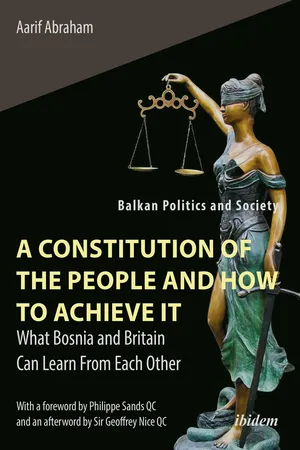
Britain does not have a written constitution. It has rather, over centuries, developed a set of miscellaneous conventions, rules, and norms that govern political behavior. By contrast, Bosnia's constitution was written, quite literally, overnight in a military hanger in Dayton, USA, to conclude a devastating war. By most standards it does not work and is seen to have merely frozen a conflict and all development with it. What might these seemingly unrelated countries be able to teach each other? Britain, racked by recent crises from Brexit to national separatism, may be able to avert long-term political conflict by understanding the pitfalls of writing rigid constitutional rules without popular participation or the cultivation of good political culture. Bosnia, in turn, may be able to thaw its frozen conflict by subjecting parts of its written constitution to amendment, with civic involvement, on a fixed and regular basis; a 'revolving constitution' to replicate some of that flexibility inherent in the British system. A book not just about Bosnia and Britain; a standard may be set for other plural, multi-ethnic polities to follow.
- English
- ePUB (mobile friendly)
- Available on iOS & Android
eBook - ePub
About this book
Table of contents
- Contents
- ACKNOWLEDGMENTS
- FOREWORD
- INTRODUCTION
- 1. “A text about a text”: constitutions of Britain and Bosnia
- 2. “Look a shoot is sprouting”: measuring culture
- 3. “Going back to whence I sprang”: assessing apathy
- 4. “We’ve still not found a cure”: constitutional rules
- 5. “We need to uncover lost paths”: modelling change
- 6. “A text about hope”: lessons from Bosnia and Britain
- BEYOND LAW, PRESCRIPTIONS AND CONCLUSIONS
- AFTERWORD
- APPENDICES
- GLOSSARY
- REFERENCES
Trusted by 375,005 students
Access to over 1.5 million titles for a fair monthly price.
Study more efficiently using our study tools.