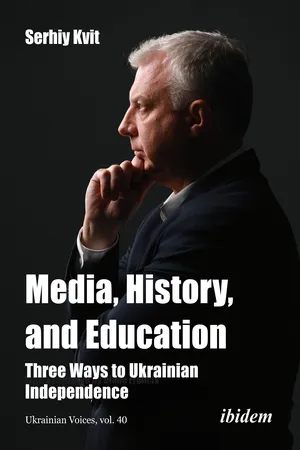
This book comprises a collection of essays that shed light on some of the key humanitarian issues that have emerged in independent Ukraine since the fall of the Soviet Union. With a strong empirical focus, the chapters explore pivotal events such as the 1990 Student Revolution on Granite (referring to the stone of Kyiv's Independence Square), the 2004 Orange Revolution (named after Viktor Yushchenko's campaign color), and the 2013–2014 Revolution of Dignity (also known as »Euromaidan«). The book examines the evolution of a robust civil society, the emergence of a Ukrainian political nation, and the ultimate achievement of national unity among Ukrainians.These developments are not only analyzed in the context of Ukraine's recent state-building successes but are also viewed as a continuation of the country's longstanding national liberation struggle for independence from Russia. Of particular note, the book highlights the ongoing re-evaluation of established stereotypes surrounding the roots of the Russian-Ukrainian conflict, which the author, Kvit, presents as a clash of civilizational values.These thought-provoking essays by one of Ukraine's most prominent political intellectuals will prove valuable not only to those with an interest in Ukraine but also to scholars across a range of disciplines, including mass communications, political science, philosophical hermeneutics, history, and higher education.
- English
- ePUB (mobile friendly)
- Available on iOS & Android
eBook - ePub
About this book
Table of contents
- Contents
- Preface
- Foreword
- Russia as Evil: False Historical Parallels Some Peculiarities of Russian Political Culture
- Skeleton Key How to Understand the Changing World during Ukraine’s War for Independence
- The Battle for History and Building of Identity Fake News Confronts Professional News
- Media, Public Rhetoric, and Culture in the Context of Ukraine’s War for Independence from Russia
- The Russia-Ukraine War through the Prism of Mass Communications
- Towards the Freedom-Seeking Mission of the Ukrainian University
- Higher Education in Ukraine in the Time of Independence Between Brownian Motion and Revolutionary Reform
- University Autonomy as a Value Basis and Necessary Environment for Academic Integrity
- A Perspective on ‘Fake News’
- Ukraine in the Struggle for Independence in the Age of Post-Truth
- Who Writes History? National Memory in the Context of Network Revolutions and Social Networks
- One Hundred Years of the Ukrainian Liberation Struggle
- The Ukrainian Liberation Movement in the Interwar Period (1923–1939)
- Ukrainian Nationalism, Ustashism, and Fascism The Matter and Context of the Discussion
- The Process, Meaning, and Consequences of Ukraine’s Revolution
- A University Degree for Carlos and “Kyiv-Mohyla 2.0” Three Criteria for a High-Quality Education
- Josyf Zisels: “Yes, I am a Ukrainian Jew”
- The Ukrainian Challenge by Professor Schlögel
- Norman Davies on the Objective and Subjective Historian
- Yaroslav Dashkevych and Subjectivity in Historical Scholarship
- About the Author
Trusted by 375,005 students
Access to over 1.5 million titles for a fair monthly price.
Study more efficiently using our study tools.