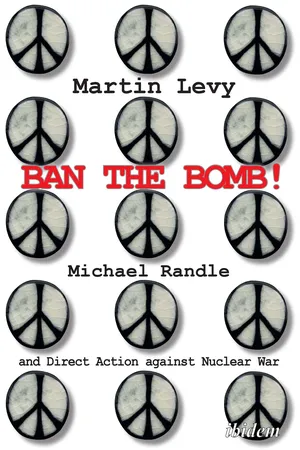
During the 1950s, Michael Randle helped pioneer a new form of direct action against nuclear war, based on the teachings of Mahatma Gandhi. At the forefront of the British campaign, he worked closely with Peace News editor Hugh Brock (1914-1985) and other distinguished 'anti-nuclear pacifists' such as Pat Arrowsmith, April Carter, and Ian Dixon, serving as chairman of the Direct Action Committee against Nuclear War (1958-1961) and secretary of the Committee of 100 (1960-1961). In 1966, he helped 'spring' the Russian spy George Blake from Wormwood Scrubs Prison. Thereafter, he campaigned vigorously on behalf of the Greek democratic opposition, conscientious objectors, and Soviet dissidents. He has always been a man of rare candor and singular energy and principles, even enduring imprisonment for his beliefs. Nowadays, Michael lives in Shipley near Bradford, where he continues to write as a respected expert on 'people power'.Martin Levy's interviews with Michael Randle introduce the reader to a tumultuous life that is nothing short of extraordinary.
- English
- ePUB (mobile friendly)
- Available on iOS & Android
eBook - ePub
About this book
Table of contents
- Contents
- Foreword
- Introduction
- 1. Family and Schooling
- 2. The Birth of a Satyagrahi
- 3. The Direct Action Committee and the first Aldermaston March
- 4. Peace News and Ghana
- 5. The Committee of 100
- 6. Marriage, The ‘Official Secrets’ Trial and Prison
- 7. Greece, Vietnam, and George Blake
- 8. The Greek Embassy ‘Invasion’ and Czechoslovakia
- 9. Peace Studies and the Alternative Defence Commission
- 10. The Blake Trial
- 11. Bradford University and Final Thoughts
- Chronology
- Acknowledgements
- Further Reading
Trusted by 375,005 students
Access to over 1.5 million titles for a fair monthly price.
Study more efficiently using our study tools.