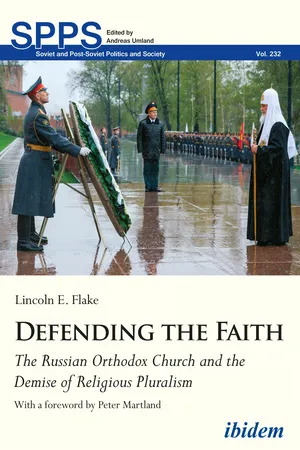
Freedom of religious expression and assembly has never been under greater threat in post-Soviet Russia. The infamous Yarovaya Law of 2016 has made good on previous legislative endeavors to curtail the activities of undesirable religious entities. Behind the curtain, the influence of the Russian Orthodox Church looms large over state policy and the decline in religious liberties and pluralism. Lincoln E. Flake explains the church's hostility to nontraditional groups as a consequence of historical-structural factors arising from its Soviet experience and immediate-strategic factors arising from its experience in the post-Soviet religious free market.It was not until the 2014 annexation of Crimea that church-state interests coincided to produce unprecedented collusion. The Church, which had previously only served symbolic purposes for domestic political advantage, was now required for more meaningful 'active measures' in Russia's all-of-government approach to advancing its national security strategy. Reciprocation produced the Yarovaya Law and further quid pro quos account for the relapse into religious intolerance.This study contextualizes the church's present-day posture on religious pluralism by appealing both to historical experience and insights that Rational Choice Theory offers to the study of religious actors and religious behavior.
- English
- ePUB (mobile friendly)
- Available on iOS & Android
eBook - ePub
About this book
Table of contents
- Contents
- Foreword by Peter Martland
- Acknowledgments
- 1. The Path of Protectionism Church, State, and an Oppressive Institutional Design for Religion
- 2. Legacies of Sovietism Structural-Historical Constraints
- 3. Post-Soviet Market Features The Immediate-Strategic Context
- 4. The Georgian Orthodox Church A Case Study in Authoritarianism
- 5. The Lithuanian Catholic Church A Case Study in Indifference
- 6. The Russian Orthodox Church Finding Its Voice at the Expense of Others
- 7. Regional Findings and Methodological Implications
- 8. Collusion That Matters Church-State Symbiosis After Crimea
- Bibliography
- Appendix: Interview/Questionnaire Questions
Trusted by 375,005 students
Access to over 1.5 million titles for a fair monthly price.
Study more efficiently using our study tools.