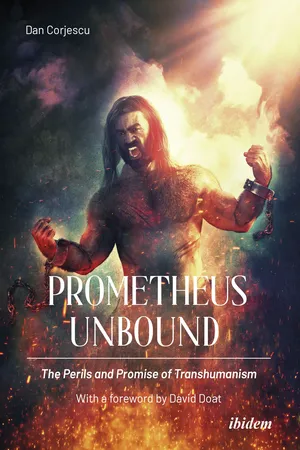
This book engages critically with some of the major assumptions of prominent Transhumanists such as Nick Bostrom of Oxford University and Stefan Sorgner of John Cabot University at Rome. More broadly, questions concerning the complex relationships between society, technology, and ethics are widely explored. Important thinkers such as St. Augustine, Nietzsche, Bertrand Russell, and C. S. Lewis are enlisted to highlight and support the main arguments presented by the author. The book aims at a general readership interested in the current claims and possible outcomes of the Transhumanist and Posthumanist movement. It strikes a cautionary note about humanity''s reliance on emerging technologies, particularly their potential to enhance and, eventually transform, human life span, cognition, and emotion.
- English
- ePUB (mobile friendly)
- Available on iOS & Android
eBook - ePub
About this book
Table of contents
- Table of Contents
- Foreword/Préface
- Introduction: First Thoughts
- Chapter One Transhumanism: Renaissance Humanism 2.0?
- Chapter Two Transhumanism: Enfant Terrible of the Enlightenment?
- Chapter Three Transhumanism: A Romantic Movement?
- Chapter Four Nietzsche Transhumanist?
- Chapter Five Futurism: The Modern Birth of the Man-Machine
- Chapter Six Transhumanism, Eugenics, and the New Man
- Chapter Seven Transhumanism, Globality, and the Terrorism of Technology
- Chapter Eight Love and Sex in the Age of the Posthuman
- Chapter Nine Immortality What is it Good For?
- Chapter Ten Posthumanism and The Meaning of Life
- Chapter Eleven The Perils and Promise of the Posthuman
- Bibliography
Trusted by 375,005 students
Access to over 1.5 million titles for a fair monthly price.
Study more efficiently using our study tools.