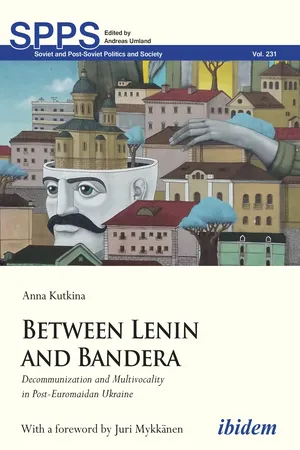
On 8 December 2013, Ukraine's central Lenin monument in Kyiv was pulled down. In the following months, in what became known as the "e;Leninfall, "e; Ukraine swept away hundreds of communist monuments, expressing an explicit desire to break away from the Soviet past and, implicitly, from Russia. This book examines the evolution of post-Euromaidan de-Sovietization beyond the issues of toppling of old statues and implementation of new anti-totalitarian laws. It explores decommunization as both a political and cultural phenomenon that exposes the multivocality of the Ukrainian population and involves various forms of dialogical interaction between ordinary citizens and the state. Posters, graffiti, or street names are physical and discursive canvases where old meanings are being contested and re-articulated, and where new political symbols that combine nationalist and democratic elements are being defined.
- English
- ePUB (mobile friendly)
- Available on iOS & Android
eBook - ePub
About this book
Table of contents
- Contents
- Preface
- Acknowledgements
- Introduction
- 1. Theory as ‘Hegemonic’ Practice
- 2. The Postcolonial Soviet
- 3. ‘Researching’ Methods
- 4. The Poster—Roots of the Lenin cult
- 5. Art of the Protest
- 6. Meanings of Lenin
- 7. Filling the ‘Pedestal’
- Conclusion
- References
- APPENDIX
Trusted by 375,005 students
Access to over 1.5 million titles for a fair monthly price.
Study more efficiently using our study tools.