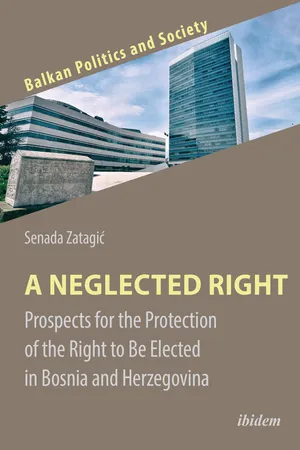
The right to be elected, although an important political right guaranteed in human rights documents on international and regional levels, is still an under-researched and undertheorized concept with many synonyms in use. While the right to vote is often correlated with democracy, the closely related right to be elected is often neglected, and the constitutions of most countries are silent about it. The 2009 European Court of Human Rights (ECtHR) decision in the case of Sejdi? and Finci v. Bosnia and Herzegovina started the discussions concerning the discrimination in enjoyment of the right to be elected in Bosnia and Herzegovina. Although the right to be elected is not explicitly guaranteed in the Dayton Constitution but only in the Law on Election, the ECtHR considered equal enjoyment of this right by everyone in Bosnia and Herzegovina of high importance and declared the relevant Dayton Constitution's provisions discriminatory. The book explains the conceptual relevance of the right to be elected, its interrelatedness with the right to vote and both these rights' significance for democratic systems. Through analyzing and explaining the regional human rights tribunal's decisions concerning the right to be elected, the importance of this political right is elucidated.
- English
- ePUB (mobile friendly)
- Available on iOS & Android
eBook - ePub
About this book
Table of contents
- Table of Contents
- ABBREVIATIONS
- TABLES
- ACKNOWLEDGEMENTS
- Introduction
- 1. The Right to be Elected as a Basic Human Right
- 2. Protection of the Right to be Elected in the European Convention on Human Rights—Case Study of Bosnia and Herzegovina
- 3. Protection of the Right to be Elected in the Americas and Africa
- Concluding Remarks
- Bibliography
Trusted by 375,005 students
Access to over 1.5 million titles for a fair monthly price.
Study more efficiently using our study tools.