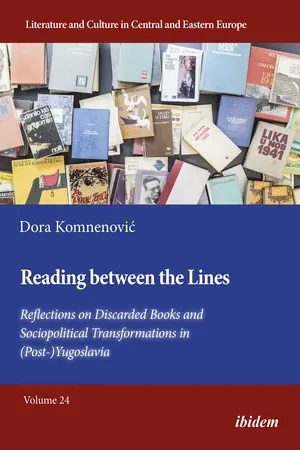
Every major socio-political change starts with some discarding. Suffice it to think about the heaps of rubbish consisting of old furniture, cars, busts of famous communist leaders, badges, and books on the streets of Eastern Europe in the fall/winter of 1989/1990. Among the institutions which have the greatest amount of experience with discarding are libraries: Counterintuitive as it may seem, libraries (but also museums and archives) regularly discard books as part of their job. In the wake of the collapse of communism in Europe, stock revision was needed in libraries, but did it unfold in a 'business as usual' fashion or was it a "bibliocide" (as it was labelled by some media in Croatia) or even "the biggest destruction of books in the post-war period" (as it was characterized by a German journalist)? When does a standard library practice start attracting public attention? What happened in Croatia that there is even a Wikipedia page about "bookicide" in the 1990s? This book approaches the issue on at least three levels (phenomenological, discursive, and theoretical) and from three angles (from the point of view of librarians, non-professionals, and, metaphorically, discarded books themselves). The aim is to offer an innovative and original interpretation of post-socialist transition and post-Yugoslav memory while at the same time providing an empirically founded case study of the inconsistencies and lack of implementation of regulations in the field of librarianship in Croatia as opposed to a seemingly more synchronized environment in Slovenia.
- English
- ePUB (mobile friendly)
- Available on iOS & Android
eBook - ePub
About this book
Table of contents
- Table of Contents
- Abstract
- Abbreviations and Acronyms
- Preface and Acknowledgments
- Introduction
- 1. Yugoslavia, Europe and the World After 1989
- 2. The Discarding of Books in the 1990s: A Fact, a Perception, a Metaphor …
- 3. The Afterlife of Discarded Books between Dumps, Library Shelves and Art
- 4. In Lieu of Conclusions: On Discarded Books, Memory and Dealing with the Socialist and Yugoslav Legacy Thirty Years Later
- Bibliography
Trusted by 375,005 students
Access to over 1.5 million titles for a fair monthly price.
Study more efficiently using our study tools.