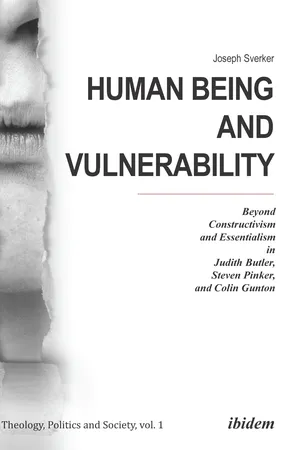
Joseph Sverker explores the division between social constructivism and a biologist essentialism by means of Christian theology. For this, Sverker uses a fascinating approach: He lets critical theorist Judith Butler, psycholinguist Steven Pinker, and systematic theologian Colin Gunton interact. While theology plays a central part to make the interaction possible, the context is also that of the school and the effect of institutions on the pupil as a human being and learner. In order to understand what underlies the division between nature and nurture, or biology and the social in school, Sverker develops new central concepts such as a kenotic personalism, a weak ontology of relationality, and a relational and performative reading of evolution. He argues that most fundamental for what it is to be human is the person, vulnerability, bodiliness, openness to the other, and dependence. Sverker concludes that the division between constructivism and essentialism discloses a deeper divide, namely that between fundamentally vulnerable persons on the one hand and constructed independent individuals on the other.
- 295 pages
- English
- PDF
- Available on iOS & Android
eBook - PDF
About this book
Table of contents
- Acknowledgments
- Introduction
- Chapter 1: From interpellated subjecthood to recognized vulnerability
- Chapter 2: Being human nature
- Chapter 3: Persons becoming in relations
- Chapter 4: Going beyond: relationality, evolutionary theory and time
- Chapter 5: Kenotic personalism
- Conclusion: persons, individuals and institutions
- Bibliography
- Index
Trusted by 375,005 students
Access to over 1.5 million titles for a fair monthly price.
Study more efficiently using our study tools.