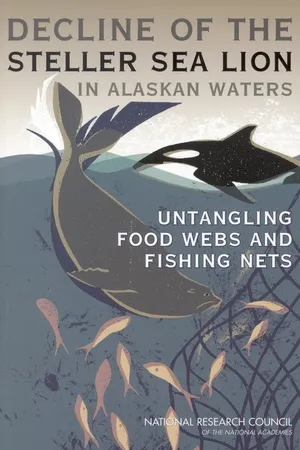
For an unknown reason, the Steller sea lion population in Alaska has declined by 80% over the past three decades. In 2001, the National Research Council began a study to assess the many hypotheses proposed to explain the sea lion decline including insufficient food due to fishing or the late 1970s climate/regime shift, a disease epidemic, pollution, illegal shooting, subsistence harvest, and predation by killer whales or sharks. The report's analysis indicates that the population decline cannot be explained only by a decreased availability of food; hence other factors, such as predation and illegal shooting, deserve further study. The report recommends a management strategy that could help determine the impact of fisheries on sea lion survival -- establishing open and closed fishing areas around sea lion rookeries. This strategy would allow researchers to study sea lions in relatively controlled, contrasting environments. Experimental area closures will help fill some short-term data gaps, but long-term monitoring will be required to understand why sea lions are at a fraction of their former abundance.
- English
- ePUB (mobile friendly)
- Available on iOS & Android
eBook - ePub
About this book
Information
Edition
0Topic
Physical SciencesTable of contents
- COVER PAGE
- THE NATIONAL ACADEMIES
- COMMITTEE ON THE ALASKA GROUNDFISH FISHERY AND STELLER SEA LIONS
- Preface
- Acknowledgments
- Contents
- Executive Summary
- 1 Introduction
- 2 The Environmental Setting
- 3 Identifying Clues and Testing Hypotheses
- 4 Review of Steller Sea Lion Biology
- 5 Fisheries
- 6 Steller Sea Lion Decline: Environmental Context and Compendium of Evidence
- 7 Information Needs and Recommendations
- References
- Appendixes
Trusted by 375,005 students
Access to over 1.5 million titles for a fair monthly price.
Study more efficiently using our study tools.
Frequently asked questions
Yes, you can cancel anytime from the Subscription tab in your account settings on the Perlego website. Your subscription will stay active until the end of your current billing period. Learn how to cancel your subscription
No, books cannot be downloaded as external files, such as PDFs, for use outside of Perlego. However, you can download books within the Perlego app for offline reading on mobile or tablet. Learn how to download books offline
Perlego offers two plans: Essential and Complete
- Essential is ideal for learners and professionals who enjoy exploring a wide range of subjects. Access the Essential Library with 800,000+ trusted titles and best-sellers across business, personal growth, and the humanities. Includes unlimited reading time and Standard Read Aloud voice.
- Complete: Perfect for advanced learners and researchers needing full, unrestricted access. Unlock 1.5M+ books across hundreds of subjects, including academic and specialized titles. The Complete Plan also includes advanced features like Premium Read Aloud and Research Assistant.
We are an online textbook subscription service, where you can get access to an entire online library for less than the price of a single book per month. With over 1.5 million books across 990+ topics, we’ve got you covered! Learn about our mission
Look out for the read-aloud symbol on your next book to see if you can listen to it. The read-aloud tool reads text aloud for you, highlighting the text as it is being read. You can pause it, speed it up and slow it down. Learn more about Read Aloud
Yes! You can use the Perlego app on both iOS and Android devices to read anytime, anywhere — even offline. Perfect for commutes or when you’re on the go.
Please note we cannot support devices running on iOS 13 and Android 7 or earlier. Learn more about using the app
Please note we cannot support devices running on iOS 13 and Android 7 or earlier. Learn more about using the app
Yes, you can access Decline of the Steller Sea Lion in Alaskan Waters by in PDF and/or ePUB format. We have over 1.5 million books available in our catalogue for you to explore.